This article provides a definitive answer to what metal fabrication is, detailing its historical evolution, the three primary types, the core processes involved, the materials most commonly used, and how modern quality control technologies are addressing the skilled labor shortage reshaping the fabrication industry.
What Is the Exact Definition of Metal Fabrication?
Metal fabrication is the overarching manufacturing process that transforms raw or semi-finished metal materials into end products, components, or structural assemblies. In Entity-Attribute-Value terms: metal fabrication (Entity) converts (Attribute) raw stock such as sheet metal, bar stock, or billets into finished parts or structures (Value). Unlike general manufacturing, which often assembles pre-made components into a consumer product, the fabrication of metal focuses on the initial creation of those components from raw material.
To define metal fabrication precisely: it is the application of cutting, forming, joining, and finishing processes to raw metal to produce a part, assembly, or structure that meets a specified design. The distinction between fabrication and manufacturing is important. Manufacturing processes raw materials into finished goods for sale to consumers. Fabrication, by contrast, creates the component parts and structural elements that manufacturing then uses. A car engine block is a fabricated part; the assembled automobile is a manufactured product.
The standard workflow in metal manufacturing and fabrication follows three phases. The first is design, where engineers use Computer-Aided Design (CAD) software or Building Information Modeling (BIM) to create precise 3D digital models. The second is fabrication, where the physical processes of cutting, bending, welding, and machining transform raw stock into the designed part. The third is installation or assembly, where fabricated components are joined into their final structure.
How Did Metal Fabrication Evolve Historically?
The history of metal fabrication is inseparable from the history of human civilization. The earliest evidence of metal fabricating dates to over 10,000 years ago, when ancient craftsmen in the Copper, Bronze, and Iron Ages used rudimentary hammering and heating techniques to shape metals into tools and weapons. These blacksmiths operated entirely on tribal knowledge — skills passed down through apprenticeship rather than written documentation. The loss of a master craftsman meant the loss of irreplaceable process knowledge, a challenge that persists in modern fabrication shops today.
The Industrial Revolution of the 18th and 19th centuries triggered the first major transformation of the fabrication industry. Steam-powered hammers and rolling mills replaced manual forging, enabling mass production of structural steel at a scale previously impossible. The expansion of railways and the construction of iron bridges and factories drove unprecedented demand for fabricated metal products. This era established the fabrication shop as a distinct commercial entity, separate from the blacksmith’s forge.
The 20th century introduced electric welding, CNC machining, and computer-aided design — three innovations that permanently redefined what metal fabricating could achieve. Techniques such as MIG welding and TIG welding replaced manual arc welding for precision applications. CNC machines eliminated human error in repetitive cutting and milling operations. By the 21st century, robotic welders, laser cutters, and waterjet systems had made it possible to produce complex geometries with tolerances measured in fractions of a millimeter, at production volumes unimaginable to the blacksmiths of the Iron Age.
What Are the Three Main Types of Metal Fabrication?
The metal fabrication industry segments its work into three primary categories, each defined by the scale, function, and end-use application of the fabricated product.
1. Industrial Metal Fabrication Industrial metal fabrication produces the heavy equipment and machinery that other sectors use to manufacture consumer goods. This category focuses on high-strength, durable components designed to withstand extreme operational stress over long service lives. Common products include industrial bandsaws, material handling equipment, storage silos, ironworking machines, and heavy machine parts. The aerospace and energy sectors rely heavily on industrial fabrication to build oil rigs, wind turbine towers, and aircraft engine mounts — components that must survive in some of the harshest environments on Earth.
2. Structural Metal Fabrication Structural metal fabrication provides the essential framework for the construction and infrastructure sectors. This type involves processing heavy steel components designed to bear massive loads over decades. Fabricators produce H-beams, I-beams, angle bars, rebars, and steel trusses that form the skeletons of skyscrapers, bridges, and industrial facilities. The Empire State Building, the Sydney Harbour Bridge, and Dubai’s Burj Khalifa were all constructed using structural steel fabricated to exact engineering specifications. Structural fabrication demands strict adherence to load-bearing calculations, dimensional tolerances, and corrosion resistance standards.
3. Commercial Metal Fabrication Commercial metal fabrication creates products for direct consumer use or commercial environments. This category requires a higher degree of aesthetic finish and dimensional precision compared to structural work. Products include automotive chassis, household appliances, restaurant equipment, guardrails, decorative awnings, and retail shelving. Commercial fabrication commonly utilizes thinner sheet metals and prioritizes rapid production cycles to meet consumer demand. The automotive industry, in particular, depends on commercial metal fabrication for body panels, wheel hubcaps, and chassis components, all produced through high-volume stamping and forming operations.
What Are the Core Metal Fabrication Processes?
The core metal fabrication processes are cutting, forming, welding, machining, stamping, casting, forging, and extrusion. Fabricators select these processes based on the material type, part geometry, required tolerances, and production volume. The table below summarizes the primary processes and their applications.
| Process | Core Technique | Best Use Case |
|---|---|---|
| Cutting | Laser, plasma, waterjet, shearing | Separating raw stock into workable sections |
| Forming/Bending | Press brake, tube bending, folding | Shaping metal without removing material |
| Welding | MIG, TIG, SMAW, robotic welding | Joining two or more metal pieces permanently |
| Machining | Drilling, milling, turning (CNC) | Removing material to achieve precise geometry |
| Stamping | Hydraulic or mechanical press with die | High-volume production of shaped sheet metal parts |
| Casting | Die casting, sand casting | Mass-producing complex identical shapes from molten metal |
| Forging | Hot, warm, or cold compressive force | Creating high-strength parts through grain alignment |
| Extrusion | Hydraulic ram through a shaped die | Producing long profiles such as pipes, rods, and frames |
1. Cutting Cutting is the foundational step in most fabrication projects. It separates raw metal stock into workable sections before any forming or joining takes place. Sawing is the oldest method, still used for straight cuts on bar stock and structural profiles. Modern fabricators rely on laser cutting for intricate geometries and tight tolerances, plasma cutting for thick conductive metals, and waterjet cutting for heat-sensitive materials where a heat-affected zone would compromise the part’s integrity.
2. Forming and Bending Forming alters the shape of a metal workpiece without removing any material. Press brakes apply massive hydraulic force to pinch sheet metal into precise angles. Tube bending machines manipulate cylindrical stock for roll cages, architectural frameworks, and exhaust systems. Folding machines create clean, repeatable creases in sheet metal for enclosures and panels. These processes require exact calculations to prevent the metal from fracturing or springback, the tendency of metal to partially return to its original shape after bending.
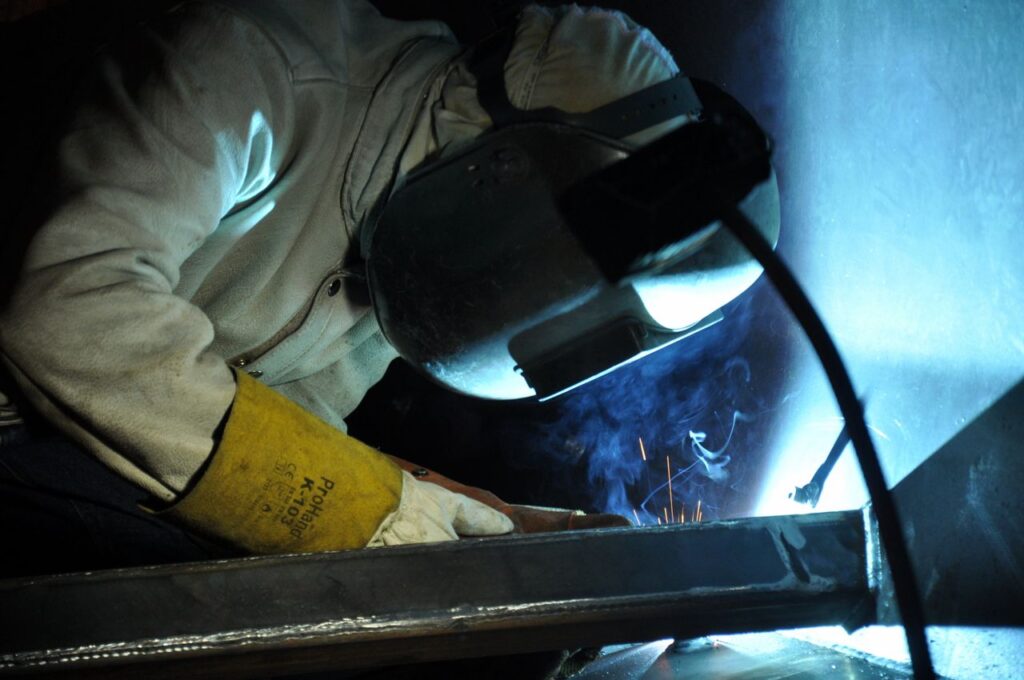
3. Welding and Joining Welding fuses two or more metal pieces using extreme heat, pressure, or both. Metal Inert Gas (MIG) welding, formally Gas Metal Arc Welding (GMAW), is the most common technique for factory environments due to its speed and versatility across a wide range of metal thicknesses. Tungsten Inert Gas (TIG) welding, or Gas Tungsten Arc Welding (GTAW), provides superior precision for thinner materials and complex joints, requiring a highly skilled operator. Shielded Metal Arc Welding (SMAW), also known as stick welding, remains essential for heavy-duty structural repairs and on-site assembly where portability matters. Robotic welding has become standard in high-output facilities, ensuring perfect consistency across thousands of identical welds per shift.
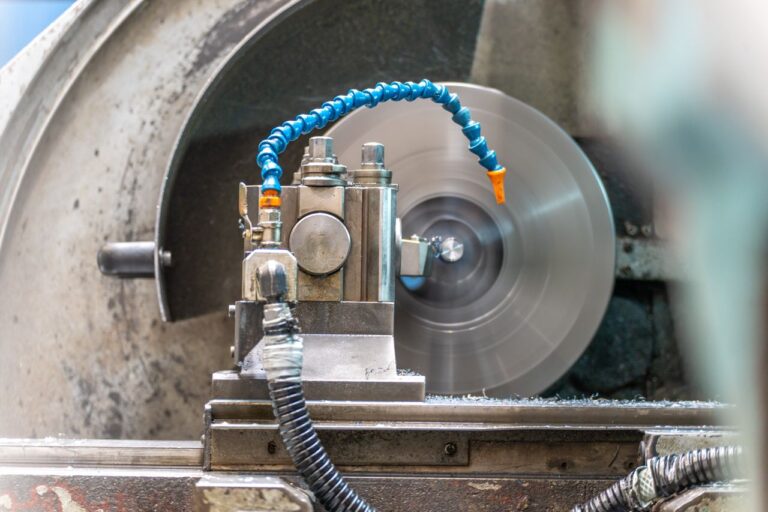
4. Machining Machining is a subtractive process that removes unwanted material from a solid block to achieve a specific shape. Drilling creates precise circular holes using a rotating drill bit pressed against the workpiece. Milling uses rotating multi-point cutting tools to progressively remove material, shaping the metal into complex three-dimensional forms. Turning rotates the workpiece against a stationary cutting tool on a lathe to produce cylindrical components such as shafts and rods. CNC machining controls all of these operations through programmed software, eliminating manual error and enabling tolerances as tight as ±0.001 inches.
5. Casting and Forging Casting involves pouring molten metal into a precisely shaped mold and allowing it to cool and harden. Die casting forces liquid metal into a steel mold under high pressure, making it ideal for high-speed production of complex shapes. Sand casting uses a sand mold for larger, more intricate designs and is more economical for low-volume runs. Forging applies compressive force, either through a hammer or a press, to shape metal. This can be done at room temperature (cold forging), slightly above room temperature (warm forging), or at the metal’s recrystallization temperature (hot forging). Forged parts exhibit superior structural integrity compared to cast parts because the forging process aligns the metal’s grain structure, making it ideal for high-stress applications such as crankshafts, landing gear, and axles.
6. Extrusion and Drawing Extrusion forces a metal billet through a die with a specific cross-sectional profile, producing long, uniform shapes such as aluminum window frames, structural channels, and pipes. Cold extrusion, performed at room temperature, increases the strength of the part by work-hardening the metal. Drawing uses tensile force to pull metal through a tapered die, stretching it into a thinner shape. This process is used to produce wire, tubing, and seamless pipes, and is performed cold to maintain dimensional accuracy.
What Are the Essential Metal Finishing Processes?
Finishing is the final stage of fabrication, applied to protect the metal from corrosion, improve its aesthetic appearance, or prepare it for final assembly. While not a shaping process, finishing is critical to the longevity of the fabricated part.
Sandblasting propels abrasive materials against the metal surface to remove rust, scale, and impurities, creating a clean profile for subsequent coatings. Powder coating applies a dry powder electrostatically, which is then cured under heat to form a hard, durable skin that is tougher than conventional paint. Hot-dip galvanizing immerses steel components in molten zinc, creating a metallurgical bond that provides decades of rust protection, an essential finish for structural steel fabrication used in outdoor environments. Anodizing is an electrochemical process used primarily on aluminum to thicken the natural oxide layer, increasing corrosion resistance and allowing for color dyeing.
Which Industries Rely on Metal Fabrication?
The fabrication industry serves as the foundational supply chain for nearly every major sector of the global economy. The applications of fabricated metal are vast and highly specialized.
Construction and Infrastructure: This sector consumes the largest volume of fabricated steel. Fabricators supply the structural frameworks for commercial high-rises, the heavy trusses for suspension bridges, and the pre-engineered building (PEB) systems used for industrial warehouses and hangars.
Automotive and Transportation: The automotive industry relies on high-volume commercial fabrication. Stamping presses produce millions of identical body panels, while robotic welding cells assemble chassis and frames. The focus here is on balancing structural rigidity for passenger safety with lightweight materials for fuel efficiency.
Aerospace and Defense: Aerospace fabrication demands the highest precision and the strictest material certifications. Fabricators use specialized alloys like titanium and magnesium to create landing gear, engine mounts, and fuselage components that must withstand extreme temperature fluctuations and atmospheric pressure.
Energy and Mining: The energy sector requires heavy industrial fabrication to build the infrastructure that powers the grid. This includes offshore oil rigs, high-pressure pipelines, nuclear reactor containment vessels, and the massive steel towers that support wind turbines.
Which Metals Are Most Commonly Fabricated?
The selection of raw material dictates both the fabrication methods available and the performance characteristics of the final product. Fabricators work with a specific set of metals, each offering distinct properties suited to different industrial requirements.
Carbon steel is the most widely used metal in the fabrication industry due to its high tensile strength, cost-effectiveness, and malleability. Structural beams (I-beams, H-beams), industrial machinery (lathes, presses), and pipelines are its primary applications. Stainless steel adds chromium to the alloy, providing exceptional corrosion resistance and a polished aesthetic — properties that make it indispensable in medical instruments (scalpels, surgical trays), commercial kitchens (prep tables, sinks), and marine environments. Aluminum offers an outstanding strength-to-weight ratio and natural corrosion resistance, making it the material of choice for aerospace components (fuselage panels), automotive frames, and architectural profiles. Its low density, roughly one-third that of steel, is critical for fuel efficiency in transportation.
Copper and its alloys (brass and bronze) are selected for their high thermal and electrical conductivity, making them essential for wiring, heat exchangers, and electronic components (circuit board connectors). Magnesium is the lightest structural metal available, with a density lower than aluminum, and is used in high-speed equipment, laptop bodies, and biocompatible medical devices (orthopedic implants). Fabricators also work with raw material forms that span all these metals: sheet metal (up to 0.25 inches thick), plate metal (above 0.25 inches), bar stock, tubes, and billets.
How Do You Choose the Right Fabrication Process?
Selecting the optimal fabrication process requires a calculated analysis of several production variables. The material type is the primary constraint: brittle metals cannot undergo severe bending, and highly reflective metals may require specialized laser settings. Part geometry and design complexity determine the machinery required: a simple straight cut uses a mechanical shear, while an intricate internal geometry requires a multi-axis CNC mill.
Production volume is the most commercially significant factor. Die casting requires a substantial upfront investment to create the mold, making it cost-prohibitive for small batches but highly economical for runs exceeding 10,000 units. CNC machining, by contrast, requires no custom tooling and is ideal for rapid prototyping and low-volume production. Stamping offers the lowest per-unit cost at high volumes for sheet metal parts, but the die cost must be amortized across the production run. Lead time, budget, and required quality tolerances complete the decision framework. A fabricator who optimizes all six variables simultaneously will consistently outperform one who focuses on any single factor.
How Do Quality Control and Safety Impact Fabrication?
The metal fabrication industry faces a critical structural challenge: a severe shortage of skilled labor. As veteran craftsmen retire, the tribal knowledge required to operate complex machinery and execute precise welds is leaving the workforce. This skills gap directly threatens both product quality and workplace safety.
Quality control in modern fabrication relies on Non-Destructive Testing (NDT) to verify structural integrity without damaging the product. Ultrasonic Testing (UT) transmits high-frequency sound waves through the metal to detect internal voids or cracks. Magnetic Particle Inspection (MPI) reveals surface and near-surface defects in ferromagnetic materials. Radiographic testing (X-ray) provides a visual cross-section of weld quality. Dimensional inspection ensures every fabricated part matches the engineering drawing to within the specified tolerance.
Safety on the fabrication shop floor requires continuous attention. Workers operate heavy CNC machinery, high-temperature welding equipment, and overhead cranes simultaneously. Proper Personal Protective Equipment (PPE), including auto-darkening welding helmets, flame-resistant clothing, and respiratory protection against metal fumes, is non-negotiable. Regular training and certification in equipment operation are equally essential.
To address the skills gap directly, forward-thinking fabricators deploy the Intelycx ARIS platform. ARIS digitizes standard operating procedures and captures the tribal knowledge of senior welders and machinists in structured, searchable formats. This enables facilities to onboard and train new fabricators 40% faster, preserving institutional knowledge before it retires. For machine uptime, the Intelycx CORE platform connects to CNC machines, press brakes, and robotic welders to monitor performance telemetry in real time across more than 2,000 machine types. This continuous oversight drives up to a 20% reduction in unplanned downtime by identifying failure patterns before they cause a breakdown.
For high-volume commercial and industrial fabrication, the Intelycx NEXACTO system provides automated visual inspection at 4.5 seconds per cycle. NEXACTO’s advanced optics detect surface defects and dimensional anomalies down to 250 microns, delivering 99%+ inspection accuracy at a throughput of 75,000 units per day. For stamped automotive parts, machined aerospace components, or precision-formed enclosures, this level of automated quality control eliminates the hidden factory — the undetected rework and scrap that silently erodes fabrication profitability.
Conclusion
Metal fabrication is the foundational process that converts raw metal into the structural and functional components that define the modern world. From the ancient blacksmith’s forge to today’s robotic welding cell, the core objective has never changed: transform raw material into a precisely specified part. What has changed is the scale, the precision, and the complexity of the processes involved. As the fabrication industry confronts the dual pressures of a retiring skilled workforce and rising quality demands, the facilities that invest in digital training platforms, real-time machine monitoring, and automated inspection will define the next era of the fabrication industry.
Glossary of Metal Fabrication Terms
Billet: A solid cylinder or block of metal used as the raw material for extrusion or forging processes.
Blanking: A punching process that cuts a specific shape out of a sheet of metal; the removed piece is the final product.
CNC (Computer Numerical Control): A manufacturing method that uses programmed software to control the movement of machine tools, enabling precise and repeatable fabrication operations.
Die: A specialized tool used in manufacturing to cut or shape material, most commonly used in stamping, casting, and extrusion.
Extrusion: A process where metal is forced through a die to create long objects with a fixed cross-sectional profile, such as pipes and structural channels.
Flux: A substance used in welding to prevent the formation of oxides and other contaminants in the weld pool, ensuring a clean and strong joint.
Heat-Affected Zone (HAZ): The area of a metal workpiece that has been altered in microstructure or properties by the heat of a welding or cutting process.
Press Brake: A machine tool used for bending sheet and plate material using a punch and die system.
Shearing: A cutting process that uses two blades to slice through metal in a straight line without the use of heat or abrasion.
How Intelycx Helps Turn Manufacturing KPIs into Daily Guidance
Manufacturing KPIs only create value when they are accurate, real-time, and connected to action. That is the gap Intelycx is built to close.
The Intelycx platform connects legacy and modern machines into a single data foundation, normalizes and enriches signals so KPIs are calculated consistently across lines and sites, and provides real-time dashboards for operators, engineers, and leaders. On top of this connected data, Intelycx layers AI-driven insights so teams understand not just what changed in a KPI, but why, and what to do about it.
If you are working to move beyond spreadsheets and lagging reports, a unified manufacturing AI platform like Intelycx can help you turn KPIs from static charts into a living system for maximizing production efficiency every day. You can learn more about our solutions and approach at Intelycx.com.