
What is Industry 4.0 Manufacturing?
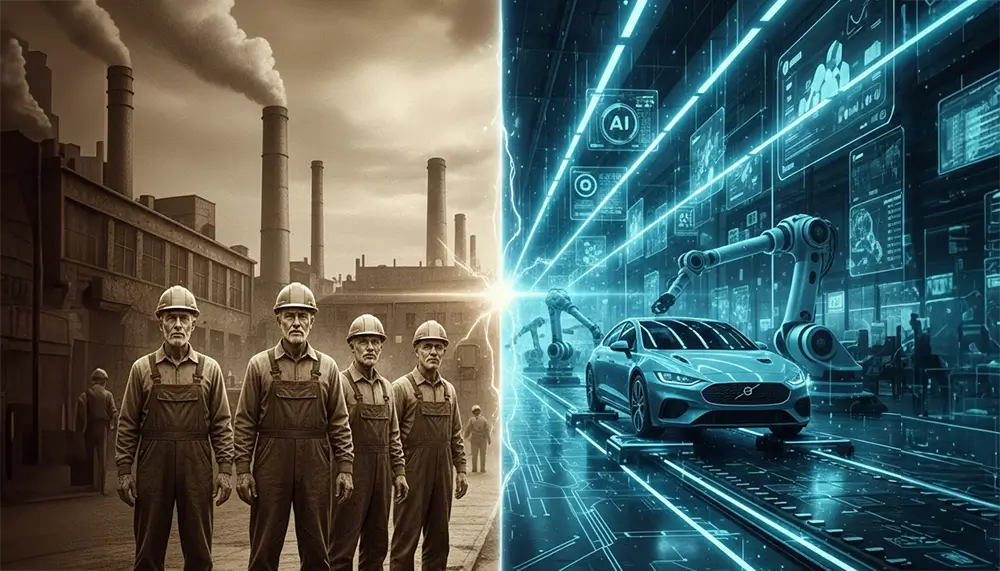
The United States manufacturing sector is facing a historic paradox. A “Manufacturing Renaissance,” fueled by aggressive reshoring and advanced technology, is colliding with a demographic “Silver Tsunami” that is draining the industry of its most valuable asset: institutional knowledge. As factories become smarter, the workforce is shrinking, creating a knowledge gap that threatens to derail this momentum. This article provides a definitive answer to “What is Industry 4.0 manufacturing?” by framing it not as a technological upgrade, but as the strategic solution to this critical workforce crisis. We will dissect the core technologies, explore the business imperatives that competitors overlook, and provide a practical roadmap for implementation. By leveraging Industry 4.0, manufacturers can decouple operational excellence from individual tenure, turning the workforce crisis into a generational opportunity for competitive advantage. Why is Manufacturing Facing a Paradox of Progress and People? We are in the midst of a manufacturing supercycle. Spurred by the supply chain vulnerabilities exposed during the pandemic and a strategic geopolitical realignment, reshoring has surged. The Reshoring Initiative reports that U.S. companies and foreign investors have announced nearly 2 million jobs since 2010, with a remarkable spike of 244,000 jobs in 2024 alone, primarily in high-tech sectors like EV batteries and semiconductors [1]. Simultaneously, this technological leap is colliding with a demographic cliff. The industry is facing a “Silver Tsunami.” The Alliance for Lifetime Income reports that over 30 million “Peak Boomers” will turn 65 between 2024 and 2029 [2]. As they retire, they take decades of unwritten, “tribal” knowledge with them—the intuition that a specific machine vibration signals a bearing failure, a nuance no manual can capture. This creates the Great Manufacturing Paradox: we have the most advanced factories in history, but we are rapidly losing the very people who know how to run them. The National Association of Manufacturers (NAM) projects a potential shortfall of 1.9 million manufacturing employees by 2033 due to this skills gap [3]. The question is no longer if this will impact your business, but when. What is Industry 4.0 Manufacturing, and Why Does It Matter Now? Industry 4.0 is the fourth industrial revolution, representing the digital transformation of manufacturing. It is a paradigm shift where physical production processes are deeply intertwined with digital technology, creating a single, intelligent system of interconnected operations. It is not just about automation; it is about creating smart factories that can sense, predict, and interact with the physical world to make autonomous, real-time decisions. To understand its significance, we must view it in historical context: Industrial Revolution Era Core Technology Impact on Manufacturing First (1.0) Late 18th Century Steam & Water Power Mechanization of production Second (2.0) Late 19th Century Electricity & Assembly Line Mass production and scale Third (3.0) Late 20th Century Computers & Automation Digitization and initial automation Fourth (4.0) Present Cyber-Physical Systems & AI Autonomous, data-driven, interconnected factories In semantic terms, Industry 4.0 can be understood through a simple framework: This means that every asset, process, and worker is connected, sharing data that is analyzed by artificial intelligence to optimize the entire value chain, from supply chain logistics to shop floor operations and quality control. What Are the Core Technologies That Power a Smart Factory? Industry 4.0 is not a single technology but a confluence of nine foundational pillars that, when integrated, create the smart factory. While many competitors list these technologies, they fail to connect them to the strategic imperative of solving the workforce paradox. Here, we dissect each pillar and its specific role in bridging the knowledge gap. 1. The Industrial Internet of Things (IIoT) The IIoT is the central nervous system of the smart factory. It consists of a network of sensors, actuators, and other devices embedded in industrial machinery that collect and transmit real-time data about the machine’s health, performance, and environment. This data can include temperature, pressure, vibration, energy consumption, and output. 2. Artificial Intelligence (AI) and Machine Learning (ML) If IIoT is the nervous system, AI and ML represent the brain. These algorithms process the immense data streams from IIoT sensors to identify patterns, predict outcomes, and prescribe actions. This includes predictive maintenance (forecasting equipment failure before it happens), anomaly detection (identifying deviations from normal operating parameters), and process optimization (recommending adjustments to improve yield or quality). 3. Cloud Computing Cloud platforms provide the scalable, on-demand computing power and storage necessary to handle the massive datasets generated by a smart factory. This eliminates the need for manufacturers to invest in and maintain expensive on-premise data centers, making advanced analytics accessible to companies of all sizes. 4. Big Data and Analytics This pillar refers to the practice of analyzing large, complex datasets (“big data”) to uncover hidden patterns, correlations, and other insights. In a manufacturing context, this means analyzing historical production data, quality data, and maintenance logs to understand the root causes of systemic issues. 5. Cybersecurity As factories become more connected, they also become more vulnerable to cyberattacks. A robust cybersecurity framework is essential to protect sensitive operational data, intellectual property, and the physical safety of the plant. This includes network security, endpoint protection, and identity and access management. 6. Digital Twins A digital twin is a virtual replica of a physical asset, process, or even an entire factory. It is fed with real-time data from IIoT sensors, allowing it to mirror the state of its physical counterpart. This enables manufacturers to run simulations, test new process parameters, and train operators in a virtual environment without disrupting physical production. 7. Additive Manufacturing (3D Printing) Additive manufacturing enables the creation of complex, three-dimensional objects directly from a digital file. In an industrial context, this is used for rapid prototyping, creating custom jigs and fixtures, and even producing on-demand spare parts for machinery. 8. Augmented Reality (AR) AR technology overlays digital information—such as step-by-step work instructions, real-time performance data, or expert video guidance—onto a user’s view of the physical world, typically through a tablet or smart glasses. 9. Autonomous Robots These are not the caged robots of the