
What is Industry 4.0 Manufacturing?
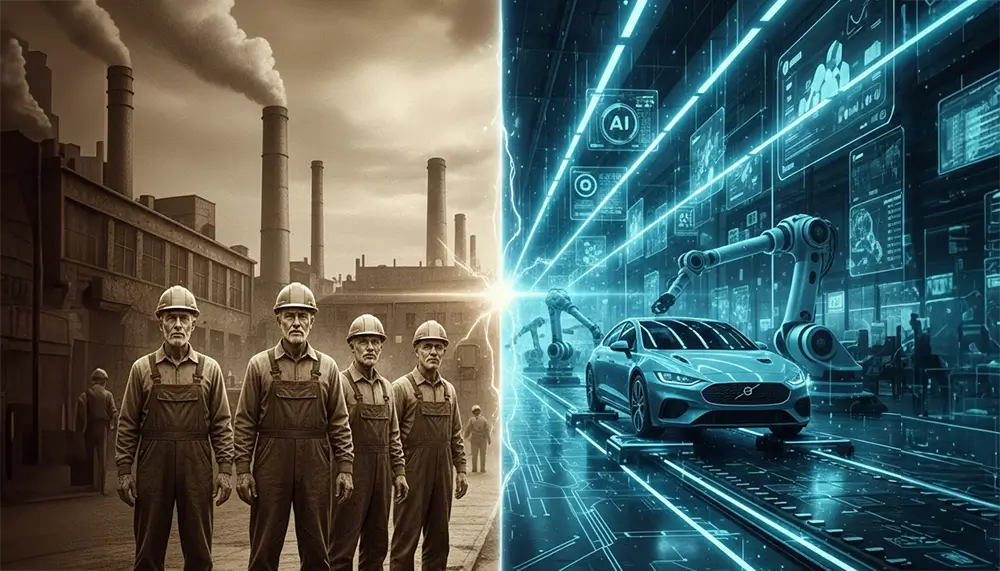
The United States manufacturing sector is facing a historic paradox. A “Manufacturing Renaissance,” fueled by aggressive reshoring and advanced technology, is colliding with a demographic “Silver Tsunami” that is draining the industry of its most valuable asset: institutional knowledge. As factories become smarter, the workforce is shrinking, creating a knowledge gap that threatens to derail this momentum. This article provides a definitive answer to “What is Industry 4.0 manufacturing?” by framing it not as a technological upgrade, but as the strategic solution to this critical workforce crisis. We will dissect the core technologies, explore the business imperatives that competitors overlook, and provide a practical roadmap for implementation. By leveraging Industry 4.0, manufacturers can decouple operational excellence from individual tenure, turning the workforce crisis into a generational opportunity for competitive advantage. Why is Manufacturing Facing a Paradox of Progress and People? We are in the midst of a manufacturing supercycle. Spurred by the supply chain vulnerabilities exposed during the pandemic and a strategic geopolitical realignment, reshoring has surged. The Reshoring Initiative reports that U.S. companies and foreign investors have announced nearly 2 million jobs since 2010, with a remarkable spike of 244,000 jobs in 2024 alone, primarily in high-tech sectors like EV batteries and semiconductors [1]. Simultaneously, this technological leap is colliding with a demographic cliff. The industry is facing a “Silver Tsunami.” The Alliance for Lifetime Income reports that over 30 million “Peak Boomers” will turn 65 between 2024 and 2029 [2]. As they retire, they take decades of unwritten, “tribal” knowledge with them—the intuition that a specific machine vibration signals a bearing failure, a nuance no manual can capture. This creates the Great Manufacturing Paradox: we have the most advanced factories in history, but we are rapidly losing the very people who know how to run them. The National Association of Manufacturers (NAM) projects a potential shortfall of 1.9 million manufacturing employees by 2033 due to this skills gap [3]. The question is no longer if this will impact your business, but when. What is Industry 4.0 Manufacturing, and Why Does It Matter Now? Industry 4.0 is the fourth industrial revolution, representing the digital transformation of manufacturing. It is a paradigm shift where physical production processes are deeply intertwined with digital technology, creating a single, intelligent system of interconnected operations. It is not just about automation; it is about creating smart factories that can sense, predict, and interact with the physical world to make autonomous, real-time decisions. To understand its significance, we must view it in historical context: Industrial Revolution Era Core Technology Impact on Manufacturing First (1.0) Late 18th Century Steam & Water Power Mechanization of production Second (2.0) Late 19th Century Electricity & Assembly Line Mass production and scale Third (3.0) Late 20th Century Computers & Automation Digitization and initial automation Fourth (4.0) Present Cyber-Physical Systems & AI Autonomous, data-driven, interconnected factories In semantic terms, Industry 4.0 can be understood through a simple framework: This means that every asset, process, and worker is connected, sharing data that is analyzed by artificial intelligence to optimize the entire value chain, from supply chain logistics to shop floor operations and quality control. What Are the Core Technologies That Power a Smart Factory? Industry 4.0 is not a single technology but a confluence of nine foundational pillars that, when integrated, create the smart factory. While many competitors list these technologies, they fail to connect them to the strategic imperative of solving the workforce paradox. Here, we dissect each pillar and its specific role in bridging the knowledge gap. 1. The Industrial Internet of Things (IIoT) The IIoT is the central nervous system of the smart factory. It consists of a network of sensors, actuators, and other devices embedded in industrial machinery that collect and transmit real-time data about the machine’s health, performance, and environment. This data can include temperature, pressure, vibration, energy consumption, and output. 2. Artificial Intelligence (AI) and Machine Learning (ML) If IIoT is the nervous system, AI and ML represent the brain. These algorithms process the immense data streams from IIoT sensors to identify patterns, predict outcomes, and prescribe actions. This includes predictive maintenance (forecasting equipment failure before it happens), anomaly detection (identifying deviations from normal operating parameters), and process optimization (recommending adjustments to improve yield or quality). 3. Cloud Computing Cloud platforms provide the scalable, on-demand computing power and storage necessary to handle the massive datasets generated by a smart factory. This eliminates the need for manufacturers to invest in and maintain expensive on-premise data centers, making advanced analytics accessible to companies of all sizes. 4. Big Data and Analytics This pillar refers to the practice of analyzing large, complex datasets (“big data”) to uncover hidden patterns, correlations, and other insights. In a manufacturing context, this means analyzing historical production data, quality data, and maintenance logs to understand the root causes of systemic issues. 5. Cybersecurity As factories become more connected, they also become more vulnerable to cyberattacks. A robust cybersecurity framework is essential to protect sensitive operational data, intellectual property, and the physical safety of the plant. This includes network security, endpoint protection, and identity and access management. 6. Digital Twins A digital twin is a virtual replica of a physical asset, process, or even an entire factory. It is fed with real-time data from IIoT sensors, allowing it to mirror the state of its physical counterpart. This enables manufacturers to run simulations, test new process parameters, and train operators in a virtual environment without disrupting physical production. 7. Additive Manufacturing (3D Printing) Additive manufacturing enables the creation of complex, three-dimensional objects directly from a digital file. In an industrial context, this is used for rapid prototyping, creating custom jigs and fixtures, and even producing on-demand spare parts for machinery. 8. Augmented Reality (AR) AR technology overlays digital information—such as step-by-step work instructions, real-time performance data, or expert video guidance—onto a user’s view of the physical world, typically through a tablet or smart glasses. 9. Autonomous Robots These are not the caged robots of the
What Is Industrial IoT (IIoT)?
The term “Industrial IoT” gets thrown around a lot, especially in conversations about smart factories, Industry 4.0, and now Industry 5.0. But for most manufacturing leaders, the real question is simpler: what is IIoT, and how does it actually improve uptime, quality, and profitability on the plant floor? This article breaks down what Industrial IoT is, how IoT in manufacturing actually works, and what to look for in an IIoT platform if you want real results, not another stalled “digital transformation” project. What Is the Industrial Internet of Things (IIoT)? The Industrial Internet of Things (IIoT) is the use of connected devices, sensors, and software to collect and analyze data from industrial equipment in real time. In manufacturing, IIoT connects machines, lines, and systems so teams can see what’s happening, why it’s happening, and what to do next to improve performance. In practice, IIoT in manufacturing means: When done right, the internet of things in manufacturing moves you from lagging, spreadsheet-based reporting to live, plant-wide visibility. What Is the Difference Between IoT and Industrial IoT? IoT (Internet of Things) is a broad term that covers consumer and commercial devices, such as smart thermostats, fitness trackers, or connected appliances. Industrial IoT, or IIoT, focuses specifically on industrial environments like factories, warehouses, and plants. IoT IIoT Environment Homes, offices, retail. Harsh industrial settings with vibration, heat, dust, and strict uptime requirements. Devices Consumer sensors, cameras, appliances. PLCs, CNC machines, robots, inspection cameras, industrial sensors, and IIoT gateways. Goals Comfort, convenience, energy savings. Reduced unplanned downtime, higher OEE, better quality, and safer, more efficient operations. Industrial IoT platforms, therefore, must handle noisy data, legacy protocols, and mission-critical uptime in a way consumer IoT software never has to. This is why generic consumer IoT tools rarely fit the demands of IoT in manufacturing. How Is IoT Used in Manufacturing? IoT in manufacturing shows up across the entire production lifecycle, from raw materials to finished goods. Common internet of things industrial applications include: Real-Time Machine Monitoring Industrial IoT devices stream data like cycle counts, temperatures, currents, and vibration into a central IIoT platform. Operations can see machine status, OEE, and bottlenecks in real time instead of waiting for next-day reports. This is one of the most common entry points for the internet of things in manufacturing. Predictive Maintenance Industrial IoT data feeds predictive models that spot patterns before a failure. For example, increased vibration on a spindle or rising motor temperature can automatically trigger a maintenance work order before unplanned downtime hits. Quality Control and Traceability IIoT solutions connect vision systems, torque tools, and inspection stations so every part carries a full digital history. When defects appear, teams can trace issues back to specific batches, shifts, or equipment conditions. Energy and Utility Monitoring IoT in factories captures energy usage by machine, line, or plant. Leaders use this insight to cut waste, shift loads, and reduce energy costs without guessing. Workforce Support and Safety Industrial IoT systems can feed data into operator dashboards or AI copilots. Operators see live KPIs, guided instructions, and alerts instead of walking the floor chasing information. These are not theoretical IIoT projects. They are practical use cases manufacturers deploy today to get measurable ROI from IoT in manufacturing. What Are Industrial IoT Devices? Industrial IoT devices are the hardware components that collect and transmit data in industrial environments. A typical industrial IoT system may include: For example, a manufacturing IoT setup might combine vibration sensors on motors, PLC data from packaging lines, and cameras on inspection stations, all routed through an IIoT gateway into an industrial internet of things platform. This combination of devices is what makes IoT in manufacturing able to monitor entire lines in real time. What Is an Industrial IoT Platform? An industrial IoT platform (or IIoT platform) is the software layer that connects all your industrial IoT devices, ingests their data, normalizes it, and makes it available as real-time insights. A robust industrial IoT platform should: Connect to Any Equipment Support legacy machine integration, modern PLCs, robots, and industrial IoT hardware using common OT protocols. Standardize Data Turn inconsistent tags and signals into a unified data model, so OEE, downtime, and throughput look the same across lines and plants. Provide Real-Time Monitoring Offer live dashboards, alerts, and trends for production, quality, and maintenance teams. Integrate with Enterprise Systems Feed clean industrial IoT data into ERP, MES, CMMS, and analytics tools without custom one-off integrations for every project. Enable AI and Advanced Analytics Serve as the trusted data foundation for AI-driven manufacturing use cases like predictive maintenance, automated visual inspection, and AI-guided troubleshooting.Think of the IIoT platform as the central nervous system that makes internet of things in manufacturing solutions usable at scale instead of isolated pilots. Platforms like Intelycx CORE are designed to be this foundation, unifying machine data across legacy and modern assets and delivering real-time visibility in weeks. What Problems Does IIoT Solve in Manufacturing? Manufacturing IoT and IIoT solutions directly address long-standing operational issues that erode margins: Lack of Real-Time Visibility Without internet of things manufacturing data, many plants rely on manual logs and delayed reports. IIoT platforms replace this with real-time factory monitoring so leaders can see issues as they develop. Unplanned Downtime Industrial IoT data lets teams track conditions that lead to failures, such as overheating drives, erratic currents, and frequent minor stops. Predictive maintenance software built on IIoT data helps reduce surprise breakdowns. Data Silos and OT/IT Disconnect It is common to see separate systems for machines, MES, ERP, and quality. IIoT in industry unifies machine data and feeds it into a single industrial IoT system, bridging operational technology (OT) and information technology (IT). Inconsistent Quality and Scrap By combining process parameters, line speed, and inspection data, internet of things industrial applications help pinpoint the exact conditions that drive defects and rework. Slow, Manual Decision-Making When engineers and supervisors spend hours pulling reports from different systems, decisions lag. IIoT data and industrial IoT software compress that cycle into minutes. What