
In the hyper-competitive landscape of 2026, the term “smart factory” has become the most overused phrase in industrial manufacturing, and simultaneously the most misunderstood. While every major enterprise software vendor claims to enable one, and every industry conference dedicates a keynote to it, most manufacturers are left with a frustrating paradox: they have invested in sensors, dashboards, and connectivity platforms, yet they still cannot answer a simple question from the CEO on a Monday morning: “Why did Line 3 go down at 2 AM, and when will it happen again?”
This is the Visibility Paradox. More data, less clarity. More connectivity, less control. More technology, more complexity.
A true smart factory does not add complexity; it eliminates it. It is not a collection of disconnected technologies bolted onto an aging shop floor. It is a unified, self-optimizing system where every machine, every operator, and every process is connected, visible, and continuously improving. This article provides a definitive answer to “what is a smart factory?” by framing it not as a technology purchase, but as a strategic transformation, one that begins with a clear definition, a rigorous roadmap, and an honest assessment of where most manufacturers actually stand today.
The Smart Factory Explained
To provide a precise smart factory definition, one must move beyond the marketing language and into the operational reality. A smart factory is a cyber-physical system, a manufacturing environment where physical assets (machines, conveyors, sensors, people) are fully integrated with digital systems (data platforms, AI models, cloud analytics) to create a facility that can monitor itself, learn from its own data, and continuously optimize its own performance.
In semantic terms, a smart factory is the holonym for a set of interconnected meronyms: machine connectivity, real-time data visibility, AI-driven analytics, automated quality control, and digital knowledge management. It is the physical embodiment of Industry 4.0, the fourth industrial revolution, which is characterized by the fusion of digital, physical, and biological systems into a seamless operational whole.
The term was first formally introduced at the Hannover Fair in 2011 by a working group led by Henning Kagermann (acatech), Wolfgang Wahlster (DFKI), and Johannes Helbig as part of Germany’s High-Tech Strategy, a government-backed initiative to secure Germany’s long-term competitiveness in manufacturing. Since then, it has evolved from a theoretical concept into a measurable operational standard. According to a landmark study by Deloitte and MAPI (Manufacturing Alliance for Productivity and Innovation), companies that have successfully implemented smart factory initiatives report average gains of 10–12% in manufacturing output, factory utilization, and labor productivity.
A smart factory is not a destination; it is a direction. It is the continuous journey from a reactive, siloed, manually-driven operation toward a proactive, integrated, AI-augmented one.
So what are smart factories in practice? They are manufacturing facilities that have made this journey, or are actively making it, by deploying the connectivity, analytics, and automation capabilities described throughout this guide.
What Is the Difference Between a Smart Factory and Smart Manufacturing?
These two terms are used interchangeably in the industry, but they represent distinct concepts with an important relationship.
Smart manufacturing refers to the practices, processes, and methodologies that leverage digital technologies to improve production outcomes. It is the “how.” It encompasses the application of IIoT, AI, and data analytics to optimize throughput, quality, and cost.
A smart factory is the physical facility where smart manufacturing takes place. It is the “where.” It is the building, the machines, the people, and the infrastructure that have been configured to enable smart manufacturing practices.
Think of it this way: smart manufacturing is the operating system; the smart factory is the hardware it runs on. You cannot have a fully realized smart factory without smart manufacturing practices, and smart manufacturing practices cannot reach their full potential without the physical infrastructure of a smart factory. The two are inseparable, and the most common mistake manufacturers make is investing in one without the other.
What Are the Four Levels of Smart Factory Evolution?
The journey to a fully autonomous smart factory is not a single leap; it is an incremental climb through four distinct levels of operational maturity. Understanding where your facility sits on this spectrum is the first step in building a credible smart factory strategy.
| Level | Name | Operational Reality | Key Capability |
|---|---|---|---|
| 1 | Connected Data | Data exists but is siloed in machines, PLCs, and spreadsheets. Accessing it requires manual effort. | Reactive |
| 2 | Predictive Analytics | Data is centralized and analyzed to identify patterns and predict future events, such as equipment failures. | Proactive |
| 3 | Prescriptive Analytics | The system not only predicts what will happen but recommends specific corrective actions to optimize outcomes. | Guideline-Driven |
| 4 | AI-Driven Automation | The system autonomously executes actions and self-optimizes the production process with minimal human intervention. | Autonomous |
The uncomfortable truth is that the majority of manufacturers today are operating at Level 1. They have sensors on their machines, but the data those sensors generate is trapped in proprietary OT (Operational Technology) systems that cannot communicate with the IT (Information Technology) infrastructure. This is the Connectivity Gap, and it is the primary reason why the promise of the smart factory has not yet been realized for most of the industry.
Moving from Level 1 to Level 2 requires solving the connectivity problem. Moving from Level 2 to Level 3 requires solving the analytics problem. Moving from Level 3 to Level 4 requires solving the trust problem, building enough confidence in the AI’s recommendations to allow it to act autonomously.
How Does a Smart Factory Work?
A smart factory operates on a continuous, three-layer feedback loop that transforms raw machine data into operational intelligence and, ultimately, into automated action.
Layer 1: The Connectivity Layer — Does Your Factory Speak a Common Language?
This is the foundation of the entire system. Industrial IoT (IIoT) sensors, gateways, and machine controllers collect data from every asset on the shop floor. The critical challenge here is that modern manufacturing environments are a Tower of Babel: different machines and controllers communicate using incompatible protocols: MTConnect, OPC-UA, Modbus, PROFINET, proprietary serial protocols, and MQTT, and no single machine type is bound to a single protocol. A CNC machine may speak MTConnect or a vendor-proprietary format; a PLC may use OPC-UA, Modbus, or PROFINET depending on its manufacturer and age. Without a platform that can translate all of these languages into a single, unified data stream, the smart factory is impossible.
This is the problem that Intelycx CORE is designed to solve. It connects to any machine, from a 30-year-old legacy lathe to a modern robotic cell, using REST APIs, MQTT, and OPC-UA, and unifies the data into a Unified Namespace (UNS): a single, coherent, real-time view of the entire facility.
Layer 2: The Intelligence Layer — What Is the Data Telling You?
Raw data is not intelligence. A machine that generates 10,000 data points per second is not a smart machine; it is a noisy one. The intelligence layer is where cloud computing platforms and big data analytics engines process this data, using machine learning algorithms to identify patterns, predict failures, and surface actionable insights. This is where the system moves from “seeing” to “understanding.”
Layer 3: The Action Layer — What Should the System Do About It?
This is where insight becomes action. Based on the analysis from Layer 2, the system can automatically dispatch a maintenance alert, adjust a machine’s operating parameters, route a defective part to a quarantine station, or deliver step-by-step repair instructions to an operator’s mobile device. This is the layer where Intelycx ARIS and Intelycx NEXACTO operate, closing the loop between data and outcome.
What Smart Manufacturing Technologies Power a Smart Factory?
A smart factory is not a single technology; it is a convergence of several enabling smart factory technologies that work together as an integrated system.
Industrial Internet of Things (IIoT): The network of sensors, actuators, and connected devices that serve as the nervous system of the smart factory, continuously collecting data from every asset on the shop floor.
Artificial Intelligence (AI) and Machine Learning (ML): The cognitive engine of the smart factory, used for predictive maintenance, computer vision-based quality inspection, root cause analysis, and production optimization.
Big Data Analytics: The tools used to process and find patterns in the massive, high-velocity datasets generated by a connected factory floor. Without analytics, connectivity produces noise, not insight.
Cloud Computing: Provides the scalable, on-demand computing power and storage needed to run the analytics and host the applications that power the smart factory.
Digital Twins: A virtual replica of a physical asset, process, or entire facility, used for simulation, testing, and optimization without disrupting live production.
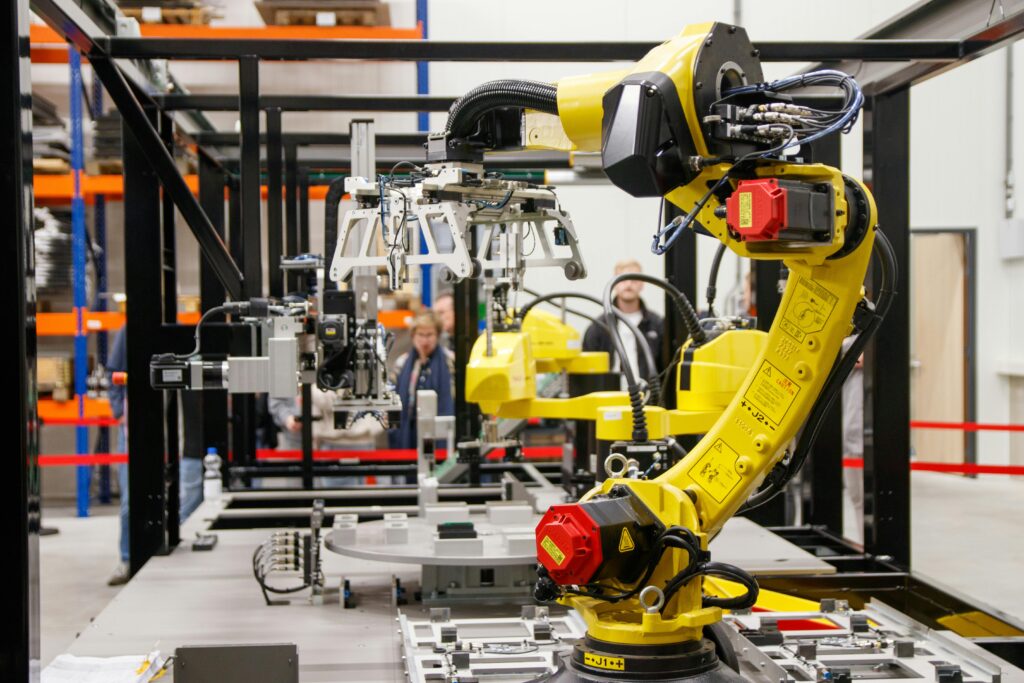
Robotics and Collaborative Automation (Cobots): The physical execution layer of the smart factory, used for assembly, material handling, welding, and painting, increasingly working alongside human operators rather than replacing them.
Edge Computing: Processing data at or near the source (the machine), rather than sending it to the cloud, to enable ultra-low-latency responses for time-critical applications like safety systems and real-time process control.
Cybersecurity: A non-negotiable layer of protection for the vast network of connected smart factory equipment. As smart factory technology continues to evolve, cybersecurity must evolve with it, every new connected device is a potential vulnerability that must be actively managed. Every connected device is a potential entry point for a cyberattack, and the consequences of a breach in a manufacturing environment can be catastrophic.
Unified Namespace (UNS): An advanced architectural concept that provides a single, unified data model for the entire factory, breaking down the silos between OT and IT systems. This is the architectural backbone of a true smart factory.
Messaging Protocols (MQTT, OPC-UA): The communication standards that allow machines, sensors, and software systems to exchange data reliably and securely across the factory network.
What Are the Benefits of a Smart Factory?
The business case for a smart factory is both clear and quantifiable. The Deloitte/MAPI study found that companies with smart factory initiatives report 10–12% average gains in manufacturing output, factory utilization, and labor productivity. A separate survey by Plex Systems found that 65% of manufacturers believe smart manufacturing is key to their future success, yet only 10% report using fully integrated smart manufacturing solutions. This gap between aspiration and execution represents the single greatest opportunity in manufacturing today.
The specific benefits of smart factory manufacturing include:
Reduced Unplanned Downtime: Predictive maintenance, powered by AI and IIoT sensor data, allows maintenance teams to address equipment issues before they cause a production stop. Intelycx CORE reduces unplanned downtime by up to 20% by providing real-time machine health monitoring and predictive alerts.
Improved Product Quality: Automated quality control systems eliminate the inconsistency of manual inspection. Intelycx NEXACTO performs 100% visual inspection at line speed, detecting defects as small as 250 microns with over 99% accuracy, and reduces overall defect rates by 30%.
Accelerated Workforce Onboarding: The “Silver Tsunami” — the mass retirement of experienced manufacturing workers — is creating a dangerous skills gap. Intelycx ARIS addresses this by capturing tribal knowledge and delivering it as AI-guided digital work instructions, accelerating employee onboarding by 40%.
Greater Operational Agility: A connected factory can respond to changes in customer demand, supply chain disruptions, or new product introductions far faster than a traditional one, because the data needed to make decisions is available in real-time.
Enhanced Sustainability: Optimized production processes consume less energy, generate less scrap, and produce less waste, directly contributing to a manufacturer’s ESG (Environmental, Social, and Governance) goals.
Improved Worker Safety: By automating hazardous tasks and providing real-time alerts for unsafe conditions, smart factories create a safer working environment for every employee on the shop floor.
What Are the Challenges of Smart Factory Implementation?
The path to a smart factory is not without obstacles. Understanding these challenges before beginning the journey is essential for building a realistic and resilient smart factory strategy.
The Legacy Integration Problem: The vast majority of manufacturing equipment in operation today was designed and built before the era of connectivity. Integrating these “dumb” machines into a smart factory network requires middleware, gateways, and protocol translation, a significant technical and financial undertaking.
The Data Silo Problem: Even in facilities that have invested in digital technology, data is often trapped in separate, incompatible systems — the MES, the ERP, the SCADA, the quality management system. Breaking down these silos to create a unified data model is one of the most complex challenges in smart factory implementation.
The Skills Gap: A smart factory requires a workforce with new skills: data analysis, AI model management, cybersecurity, and digital systems integration. According to Deloitte, the US manufacturing sector could face a shortage of 2 million workers over the next decade as the industry’s digital transformation accelerates faster than the workforce can adapt.
The Cybersecurity Threat: Every connected device in a smart factory is a potential entry point for a cyberattack. As OT and IT networks converge, the attack surface expands dramatically. A successful cyberattack on a smart factory can halt production, compromise product quality, and expose sensitive intellectual property.
The Change Management Challenge: Technology is rarely the hardest part of a smart factory transformation. Culture is. Overcoming resistance from operators, supervisors, and middle management who are accustomed to doing things “the way they’ve always been done” is often the most significant barrier to success.
The ROI Measurement Problem: Many manufacturers struggle to build a compelling business case for smart factory investment because they lack the baseline data needed to measure improvement. This is a self-reinforcing problem: without the connectivity to measure current performance, it is impossible to quantify the value of improving it.
What Is Smart Factory as a Service (SFaaS)?
To address the challenge of high initial capital investment, a new delivery model is emerging: Smart Factory as a Service (SFaaS). This is a subscription-based offering that provides manufacturers with access to a pre-built, cloud-hosted smart factory platform, including connectivity, analytics, and applications, without requiring a massive upfront expenditure on hardware, software licenses, or implementation services.
The SFaaS model democratizes the smart factory. It allows mid-market and smaller manufacturers, who have historically been priced out of enterprise-grade smart factory solutions, to access the same capabilities as their larger competitors, at a fraction of the cost and in a fraction of the time.
Intelycx is a pioneer in this space. Its suite of smart factory solutions — CORE, ARIS, and NEXACTO — is designed to be deployed incrementally and scaled as needed. A manufacturer can begin with a single CORE deployment on a single critical machine, prove the ROI, and then expand across the entire facility. This “Think Big, Start Small, Scale Fast” approach ensures that the investment is always justified by demonstrated results, not theoretical projections.
How Do You Build a Smart Factory Strategy?
A successful smart factory strategy is not a technology procurement plan; it is a business transformation roadmap. The most effective approach follows a structured, phased methodology.
Phase 1: Assess and Baseline. Before investing in any technology, conduct a rigorous assessment of your current state. Identify your highest-cost operational problems, whether that is unplanned downtime, quality defects, or slow changeovers. Establish a quantitative baseline for each. This baseline is the foundation of your ROI calculation and the benchmark against which all future improvements will be measured.
Phase 2: Connect and Unify. Solve the connectivity problem first. Deploy a machine connectivity platform like Intelycx CORE to establish the data foundation. Without a reliable, real-time data stream from your assets, every subsequent investment in analytics and AI is built on sand. The goal of this phase is to achieve Level 1 and Level 2 maturity on the smart factory evolution scale.
Phase 3: Analyze and Predict. Once you have a unified data stream, deploy the analytics layer. Use machine learning models to identify patterns in your data, predict equipment failures, and surface the root causes of your quality defects. The goal of this phase is to move from a reactive posture to a proactive one, from “firefighting” to “fire prevention.”
Phase 4: Automate and Scale. With a proven analytics foundation, begin automating the responses to the insights your system generates. Deploy automated quality inspection with Intelycx NEXACTO. Standardize tribal knowledge with Intelycx ARIS. Then scale the solution across other machines, lines, and facilities. The goal of this phase is to achieve Level 3 and Level 4 maturity.
Phase 5: Continuously Improve. A smart factory is never “done.” It is a continuously improving system. Establish a formal governance process — a Digital Kaizen cadence — to review the data, identify new improvement opportunities, and implement changes on a regular basis.
How Does a Smart Factory Apply Across Industries?
The principles of the smart factory are universal, but the applications are industry-specific. The smart factory industry context shapes which technologies are prioritized and which use cases deliver the highest ROI.
How Is a Smart Factory Used in Automotive Manufacturing?
In the automotive sector, the smart factory is primarily focused on maximizing throughput and eliminating unplanned downtime on high-speed, capital-intensive production lines. Predictive maintenance on robotic welding cells and stamping presses is the highest-value use case, as a single unplanned stop on an automotive assembly line can cost tens of thousands of dollars per hour. Real-time OEE tracking, automated visual inspection of painted surfaces, and digital work instructions for complex assembly tasks are also critical applications. Intelycx CORE connects directly to the PLCs and SCADA systems that control these lines, providing the real-time data needed to predict failures before they occur.
How Is a Smart Factory Used in Pharmaceutical Manufacturing?
In the pharmaceutical sector, the smart factory is primarily focused on compliance and quality. FDA 21 CFR Part 11 requires complete electronic traceability for every batch of product. Smart factory technologies enable this through automated electronic batch records, real-time environmental monitoring (temperature, humidity, pressure), and AI-powered visual inspection of tablets, capsules, and packaging. Intelycx NEXACTO maintains FDA compliance by providing a complete, auditable record of every inspection performed, and Intelycx ARIS ensures that operators follow the correct Standard Operating Procedures (SOPs) at every step of the process.
How Is a Smart Factory Used in Electronics Manufacturing?
In electronics manufacturing, the smart factory is focused on micro-defect detection and yield optimization. Automated Optical Inspection (AOI) systems powered by computer vision can detect solder bridges, missing components, and misaligned parts on printed circuit boards (PCBs) at speeds that are impossible for human inspectors. Smart factory analytics can also identify the specific machine parameters: paste volume, reflow temperature profile, component placement accuracy, that are correlated with higher defect rates, enabling process engineers to optimize the SMT line for maximum First Pass Yield (FPY).
How Is a Smart Factory Used in Food and Beverage Manufacturing?
In food and beverage, the smart factory is focused on food safety, waste reduction, and regulatory compliance. Track-and-trace systems provide complete lot-level traceability from raw ingredient to finished product, enabling rapid and targeted recalls if a contamination event occurs. Smart factory analytics can optimize clean-in-place (CIP) cycles, reducing water and chemical consumption without compromising hygiene standards. Predictive maintenance on filling and packaging lines minimizes the product waste associated with unplanned stops.
What’s Next for Smart Factory
The evolution of the digital smart factory is accelerating. The next frontier is Industry 5.0, which seeks to create a more human-centric, sustainable, and resilient manufacturing ecosystem, one where AI augments human capability rather than replacing it.
The most significant near-term development is the rise of AI-augmented manufacturing, where generative AI models are integrated directly into the production workflow. Imagine a system where, when a machine fails at 2 AM, the AI not only identifies the root cause in seconds but also uses a generative AI model — like Intelycx ARIS — to walk the on-call technician through the repair process step by step, in plain language, on their mobile device. This is not a future concept; it is a present-day capability.
Looking further ahead, we are moving toward Self-Healing Systems: factories where the AI can not only predict a failure but actively intervene to prevent it, adjusting machine parameters, re-routing production, or ordering spare parts, without any human intervention. This is the Level 4 autonomous smart factory, and it is the ultimate destination of the smart factory journey.
The manufacturers who begin this journey today, who invest in the connectivity, the data foundation, and the AI capabilities that make this future possible, will be the ones who define the competitive landscape of the next decade.
How Does Intelycx Enable the Smart Factory?
Intelycx provides a complete, end-to-end smart factory system through three integrated platforms that address the three most critical operational challenges in manufacturing today.
Intelycx CORE — The Machine Connectivity Platform: CORE solves the foundational connectivity problem. It connects to any machine, new or legacy, using REST APIs, MQTT, and OPC-UA, and unifies the data into a single, real-time stream. It provides real-time OEE monitoring, predictive maintenance alerts, and the data foundation needed for every other smart factory application. CORE reduces unplanned downtime by up to 20%.
Intelycx ARIS — The AI-Powered Knowledge Management Platform: ARIS solves the skills gap problem. It captures tribal knowledge from veteran operators and transforms it into interactive, AI-guided digital work instructions delivered via a chat-based, voice-enabled mobile app. ARIS accelerates employee onboarding by 40% and ensures that every operator — regardless of experience level — has access to expert-level guidance at the moment they need it.
Intelycx NEXACTO — The AI-Powered Visual Inspection Platform: NEXACTO solves the quality control problem. It automates 100% visual inspection at line speed, detecting defects as small as 250 microns with over 99% accuracy, processing up to 75,000 units per day at a cycle time of 4.5 seconds per unit. It reduces overall defect rates by 30% and maintains FDA compliance through a complete, auditable inspection record.
Together, CORE, ARIS, and NEXACTO form a complete smart factory and smart manufacturing solution. CORE provides the data; ARIS delivers the knowledge; NEXACTO ensures the quality. This is not three separate products; it is one integrated system designed to move manufacturers from the Visibility Paradox to a state of true operational intelligence.
Smart Factory vs. Traditional Factory: What Is the Real Difference?
| Feature | Traditional Factory | Smart Factory |
|---|---|---|
| Connectivity | Isolated, disconnected machines | Fully integrated cyber-physical system |
| Data | Siloed, manual, and lagging | Centralized, automated, and real-time |
| Decision-Making | Experience-based, intuitive | Data-driven, predictive, and prescriptive |
| Maintenance | Reactive (run-to-failure) | Predictive (fix-before-failure) |
| Quality Control | Manual sampling, end-of-line inspection | 100% automated, inline inspection |
| Workforce | Expertise locked in individuals | Knowledge captured and distributed digitally |
| Flexibility | Rigid, slow to adapt | Agile, continuously self-optimizing |
| Visibility | Limited to what supervisors can see | Complete, real-time visibility across all assets |
Technical Glossary
Cyber-Physical System (CPS): A system that tightly integrates computational algorithms with physical processes, such as machines and sensors, enabling real-time monitoring and control.
Digital Twin: A virtual model of a physical object, process, or system that is continuously updated with real-world data to enable simulation, analysis, and optimization.
Edge Computing: A distributed computing paradigm that processes data at or near the source (the machine), rather than sending it to a central cloud server, to reduce latency and bandwidth consumption.
IIoT (Industrial Internet of Things): The network of interconnected sensors, machines, and devices in an industrial setting that collect and exchange data to enable smart manufacturing.
Industry 4.0: The fourth industrial revolution, characterized by the fusion of digital technologies (AI, IIoT, cloud computing) with physical manufacturing processes.
Industry 5.0: The emerging fifth industrial revolution, focused on human-centricity, sustainability, and resilience, where AI augments human capability rather than replacing it.
MQTT (Message Queuing Telemetry Transport): A lightweight, publish-subscribe messaging protocol widely used for IIoT communications due to its low bandwidth requirements.
OEE (Overall Equipment Effectiveness): The gold standard for measuring manufacturing productivity, calculated as Availability × Performance × Quality.
OPC-UA (Open Platform Communications Unified Architecture): A machine-to-machine communication protocol for industrial automation that provides a secure, reliable, and platform-independent data exchange standard.
Smart Factory as a Service (SFaaS): A subscription-based model for delivering smart factory capabilities: connectivity, analytics, and applications, without requiring a large upfront capital investment.
Tribal Knowledge: Operational expertise and best practices that exist only in the minds of experienced workers and are not formally documented or transferable.
Unified Namespace (UNS): A centralized, hierarchical data model that provides a single source of truth for all data in a smart factory, breaking down the silos between OT and IT systems.
How Intelycx Helps Turn Manufacturing KPIs into Daily Guidance
Manufacturing KPIs only create value when they are accurate, real-time, and connected to action. That is the gap Intelycx is built to close.
The Intelycx platform connects legacy and modern machines into a single data foundation, normalizes and enriches signals so KPIs are calculated consistently across lines and sites, and provides real-time dashboards for operators, engineers, and leaders. On top of this connected data, Intelycx layers AI-driven insights so teams understand not just what changed in a KPI, but why, and what to do about it.
If you are working to move beyond spreadsheets and lagging reports, a unified manufacturing AI platform like Intelycx can help you turn KPIs from static charts into a living system for maximizing production efficiency every day. You can learn more about our solutions and approach at intelycx.com.