The modern manufacturing floor is currently navigating a high-stakes contradiction. As production speeds accelerate to meet global demand, the margin for error has narrowed to near-zero, yet the “Silver Tsunami” of retiring quality inspectors is draining facilities of their most critical asset: the ability to “see” a defect before it leaves the plant. This creates the Quality Paradox: manufacturers have more automated sensors than ever, yet they face rising costs from scrap, rework, and recalls. Without a robust framework, data becomes a liability rather than a tool for excellence. As tribal knowledge exits the shop floor, the ability to maintain and improve quality becomes a critical vulnerability rather than a competitive advantage.
This article provides a definitive answer to “what does quality control mean” in the context of 2026 manufacturing. We will define quality control, explore the strategic pillars of industrial quality control, and demonstrate how modern quality control systems decouple expertise from individuals to secure long-term profitability.
Define Quality Control: What Does Quality Control Mean?
To define quality control (QC) accurately, one must view it as a systematic process used to ensure that manufactured products meet a defined set of quality criteria or fulfill the requirements of the customer. In a manufacturing environment, quality control is the tactical execution of inspection and testing protocols designed to identify and eliminate defects before they reach the final user. It is the “last line of defense” that protects both the brand’s reputation and the consumer’s safety. In semantic terms, it is the process of moving a manufacturing system from a state of high entropy (defects) to a state of high conformance (value) through the constant application of the PDCA (Plan-Do-Check-Act) cycle.
While the terms are often used interchangeably, it is critical to distinguish QC from Quality Assurance (QA) and the broader Quality Management System (QMS). Quality control management is primarily reactive and product-oriented, focusing on defect detection. In contrast, Quality Assurance is proactive and process-oriented, focusing on defect prevention. A world-class manufacturing operation requires both: a QA framework to design stable processes and a QC system to verify that those processes are performing as intended. The QMS serves as the overarching organizational structure that integrates both, ensuring that quality is not an isolated department but a core business strategy.
| Feature | Primary Quality Control (QC)Focus | Key Quality Assurance (QA) | Quality Management System (QMS) Tool |
|---|---|---|---|
| Focus | Product-Oriented (Detection) | Process-Oriented (Prevention) | Organizational-Oriented (Strategy) |
| Goal | Identify and fix defects | Improve processes to prevent defects | Align quality with business goals |
| Activity | Testing, Inspection, Sampling | Audits, Training, Process Design | Policy, Planning, Resource Mgmt |
Nature | Reactive | Proactive | Strategic |
Why is Industrial Quality Control the Backbone of Manufacturing?
Industrial quality control is the strategic engine that converts raw production data into operational resilience. In the US market, where regulatory standards from bodies like the FDA and NIST are non-negotiable, QC is not merely a cost center; it is a risk mitigation strategy. Effective quality control management ensures that every unit leaving the facility conforms to the “Standard Work” established by the engineering team, thereby reducing the “Cost of Quality”—which can consume up to 20% of a manufacturer’s total sales if left unmanaged.
The Economic Impact: Cost of Poor Quality (COPQ)
To truly understand the value of quality control management, one must look beyond the surface-level expenses of a quality department. The Cost of Poor Quality (COPQ) is a metric that quantifies the total financial impact of failing to produce a perfect product the first time. In many US manufacturing facilities, COPQ can range from 15% to 40% of total revenue, yet much of this is “hidden” within standard operating costs.
The economic impact of quality is often visualized as an iceberg. The visible costs—scrap, rework, and warranty claims, are easily measured. However, the hidden costs, lost capacity, brand damage, and the “hidden factory” of unofficial rework—are far more destructive. By implementing rigorous quality control systems, manufacturers can achieve:
- Enhanced Customer Trust: Delivering consistent product performance that secures long-term contracts and market share in a volatile global economy.
- Reduced Scrap and Rework: Identifying non-conformance early in the production cycle prevents the “compounding cost” of adding value to a defective part.
- Regulatory Compliance: Maintaining the detailed documentation and traceability required for ISO 9001, AS9100, and other industry-specific certifications.
The Toolkit of Industrial Quality Control: Methodologies and Metrics
To achieve sustained excellence, industrial quality control relies on a suite of mathematical and philosophical tools. These methodologies provide the structure needed to move beyond “gut feeling” and into data-driven decision-making.
1. Statistical Process Control (SPC)
SPC is the mathematical heart of industrial quality control. By using control charts (like X-bar and R charts), quality managers can distinguish between “common cause” variation (inherent to the process) and “special cause” variation (indicative of a problem). This allows for intervention before a process drifts out of tolerance, effectively turning a reactive QC check into a proactive quality signal. A key metric here is Cp/Cpk (Process Capability Index), which measures how well a process can produce parts within specification limits.
2. Six Sigma and DMAIC
Six Sigma is a data-driven methodology aimed at reducing process variation and eliminating defects. It utilizes the DMAIC (Define, Measure, Analyze, Improve, Control) framework to solve complex problems. A process reaching Six Sigma status produces fewer than 3.4 defects per million opportunities (DPMO), ensuring near-perfect quality. This level of precision is essential for high-reliability industries where a single failure can be catastrophic.
3. Lean Manufacturing and Jidoka
While Lean is often associated with speed, its contribution to quality is found in the concept of Jidoka—or “automation with a human touch.” Jidoka empowers machines and operators to detect anomalies and stop production instantly to prevent the creation of defective parts. This prevents the “mass production of waste” and ensures that quality is built-in at every station.
Product Quality Control Testing: A Multi-Industry Deep Dive
Product quality control testing is the physical verification of a product’s attributes against its specifications. Depending on the industry, this can range from simple dimensional checks to complex chemical analyses.
1. Automotive Manufacturing
In the automotive sector, product quality control testing focuses on dimensional tolerance and material integrity. Coordinate Measuring Machines (CMM) are used to verify that body panels and engine components meet tolerances as tight as 5 microns. A failure in these metrics can lead to improper door seals, wind noise, or catastrophic engine failure, directly impacting long-term vehicle reliability and brand equity.
2. Aerospace and Defense
Aerospace manufacturers must adhere to the rigorous AS9100 standards. Industrial quality control here involves Non-Destructive Testing (NDT) methods, such as ultrasonic or X-ray inspection, to detect internal cracks in turbine blades or fuselage components without damaging the part. Every component must have 100% traceability, ensuring that any defect can be traced back to its raw material batch and specific production conditions.
3. Electronics and SMT
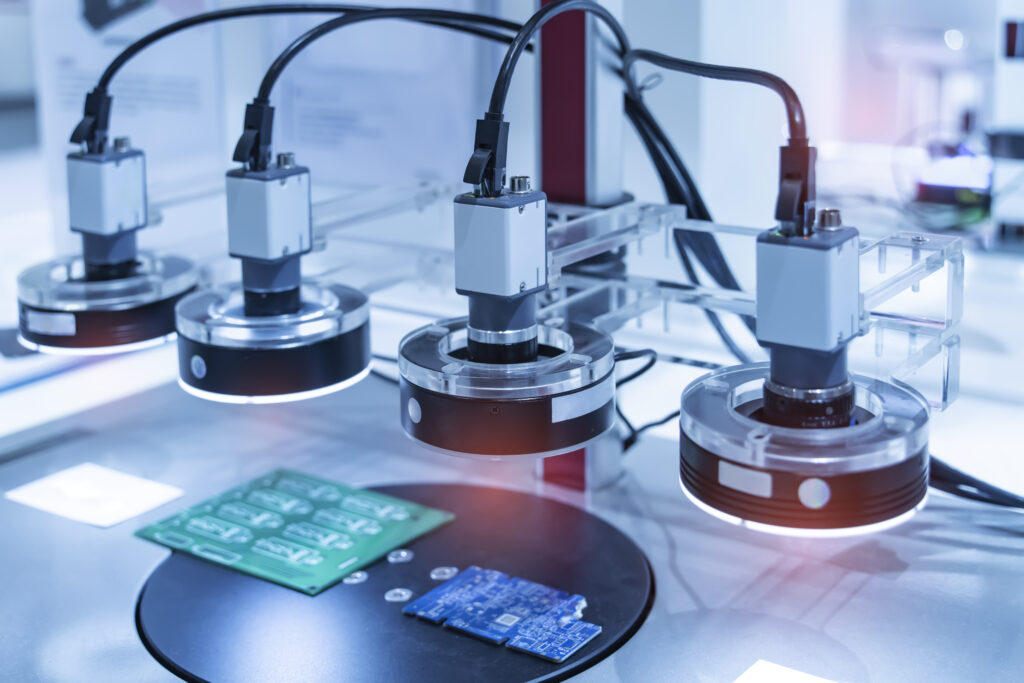
In high-volume electronics assembly, Automated Optical Inspection (AOI) systems use high-resolution cameras and AI algorithms to check thousands of solder joints per minute. These quality control systems detect bridges, voids, or missing components that are invisible to the human eye, ensuring that complex circuit boards function correctly before they are embedded in consumer or industrial products.
4. Life Sciences and Food Safety
For medical devices and food production, QC is a matter of public safety. Manufacturers must follow Good Manufacturing Practice (GMP) and FDA 21 CFR Part 11 regulations. Testing involves chemical analysis, sensory evaluation, and rigorous packaging integrity checks to prevent contamination and ensure that every batch meets strict flavor, potency, and safety profiles.
Quality Control Systems Architecture: From Shop Floor to Enterprise
Modern quality control systems are no longer isolated silos of data. They are integrated architectures that connect the physical shop floor to the enterprise resource planning (ERP) system. This connectivity ensures that quality data is actionable, transparent, and permanent.
1. Laboratory Information Management Systems (LIMS)
In industries requiring extensive material testing, such as chemicals or pharmaceuticals, a LIMS is essential. These quality control systems manage the entire lifecycle of a sample—from collection and testing to reporting and archiving. By automating data entry, LIMS eliminates the transcription errors that plague manual QC processes and ensures compliance with regulatory data integrity standards.
2. Acceptance Sampling and AQL
While 100% inspection is the goal, many manufacturers still rely on acceptance sampling for high-volume, low-cost components. This involves using the Acceptable Quality Level (AQL)—the maximum percentage of defects that is considered acceptable for a given batch. By using the Operating Characteristic (OC) curve, quality managers can balance the “Producer’s Risk” (rejecting a good batch) against the “Consumer’s Risk” (accepting a bad batch), ensuring a statistically sound approach to product quality control testing.
3. MES and ERP Integration
For quality to be a strategic advantage, it must be integrated into the Manufacturing Execution System (MES) and ERP. This allows for real-time “Quality Gates” where a production order cannot proceed to the next stage unless the QC requirements have been met. This level of quality control management ensures that non-conforming material is quarantined immediately, preventing it from being shipped to the customer.
The Digital Frontier: AI, Computer Vision, and NEXACTO
Traditional quality control is often a bottleneck, relying on manual sampling that only catches defects after they have already been produced. Human inspectors, while skilled, are subject to fatigue, subjectivity, and the “Tribal Knowledge” gap. Research shows that human inspection accuracy can drop significantly after just two hours of repetitive work.
The Power of Computer Vision
Industry 4.0 transforms this through “Predictive Quality.” AI-powered computer vision systems can perform 100% inspection at line speed, identifying defects with a level of consistency and precision that humans cannot match. These quality control systems do not just “see” a defect; they categorize it, measure its severity, and provide the data needed for root cause analysis.
Intelycx NEXACTO: Digitizing Expert Intuition
Intelycx NEXACTO represents the pinnacle of modern industrial quality control. By using advanced AI models, NEXACTO performs 100% visual inspection across every shift, maintaining 99%+ accuracy. It effectively “digitizes” the intuition of your most experienced quality leads, ensuring that their expertise is embedded in the production line 24/7. When combined with Intelycx CORE, which streams real-time machine data, manufacturers can correlate quality defects with specific machine conditions (e.g., a spike in vibration or temperature). This moves the facility from “detect and discard” to a proactive “predict and prevent” model.
Building a Culture of Quality Excellence
Scrap aBuilding a sustainable quality control management strategy requires a phased approach that integrates people, processes, and technology. It is not enough to have the best tools; you must have a culture that values quality at every level.
1. Root Cause Analysis (RCA) and FMEA
When a defect is detected, the system must trigger a structured investigation. Failure Mode and Effects Analysis (FMEA) is a proactive tool used to identify potential failure points before they occur. If a failure does happen, tools like the 5 Whys or Ishikawa (Fishbone) Diagrams are used to find the root cause. This ensures that quality control drives permanent process improvement rather than just temporary fixes.
2. Standard Work and Kaizen
Quality is the result of repeatable processes. “Standard Work” instructions represent the current best way to perform a task. As Taiichi Ohno, the father of the Toyota Production System, famously said, “Without standard work, there is no Kaizen.” By standardizing quality checks, you create a baseline that can be measured and improved.
3. Empowering the Frontline with ARIS
Intelycx ARIS empowers operators by delivering AI-guided quality instructions directly to the shop floor. This ensures that even new employees can perform complex quality checks with the precision of a veteran. By providing real-time feedback and guidance, ARIS ensures that quality is “built-in” at every station, rather than just “checked-at” the end of the line.
The Future of Quality: Autonomous Quality and the 2026 Outlook
As we look toward 2026, the role of quality control is evolving from a department into an autonomous function. We are entering the era of “Self-Correcting Systems,” where machines adjust their own parameters in real-time based on feedback from AI-powered QC systems. In this landscape, quality is no longer a hurdle to be cleared; it is the ultimate competitive moat.
By committing to advanced quality control systems, you transform your facility from a reactive environment into a proactive, learning organization. This agility is the only true defense against disruption and the only guaranteed path to long-term profitability in the global manufacturing renaissance.
Technical Glossary of Quality Control Terms
OIn the past, continuous improvement in manufacturing was hampered by the “lagging indicator” problem. TTo navigate the complex landscape of industrial quality control, professionals must master a specific lexicon of technical terms. Below is a definitive glossary of the most critical concepts used in modern quality control systems.
Value Stream Mapping (VSM): A lean-management method for analyzing the current state and designing a future state for the series of events that take a product or service from its beginning through to the customer.
Acceptable Quality Level (AQL): The worst-case fraction defective that is still considered acceptable as a process average.
Calibration: The process of comparing a measuring instrument against a known standard to ensure its accuracy.
Corrective and Preventive Action (CAPA): A regulatory concept (common in FDA and ISO environments) that focuses on investigating and solving systemic quality issues.
Defects Per Million Opportunities (DPMO): A Six Sigma metric that provides a standardized way to measure quality across different processes and industries.
Failure Mode and Effects Analysis (FMEA): A step-by-step approach for identifying all possible failures in a design, a manufacturing or assembly process, or a product or service.
First Pass Yield (FPY): The percentage of units that move through a process without requiring any rework or being scrapped.
Ishikawa Diagram: Also known as a “Fishbone Diagram,” this tool is used to visualize the potential causes of a specific quality problem.
Metrology: The scientific study of measurement, which provides the foundation for all product quality control testing.
Non-Conformance Report (NCR): A formal document used to record any material, component, or process that does not meet the specified requirements.
Overall Equipment Effectiveness (OEE): A key performance indicator that measures how well a manufacturing operation is utilized compared to its full potential, with “Quality” being one of its three core components.
Statistical Process Control (SPC): The use of statistical techniques to control a process or production method.
Total Quality Management (TQM): A management approach to long-term success through customer satisfaction, where all members of an organization participate in improving processes.
References
[1] National Association of Manufacturers (NAM). (2025). The State of the Manufacturing Workforce in 2025. https://nam.org/the-state-of-the-manufacturing-workforce-in-2025-33321/
[2] National Institute of Standards and Technology (NIST). (2024). Annual Report on the U.S. Manufacturing Economy. https://www.nist.gov/publications/annual-report-us-manufacturing-economy-2024
[3] ISO. (2024). ISO 9001:2015 Quality Management Systems. iso.org/standard/62085.html [4] FDA. (2024). 21 CFR Part 11: Electronic Records; Electronic Signatures. https://www.fda.gov/regulatory-information/search-fda-guidance-documents/part-11-electronic-records-electronic-signatures-scope-and-application
How Intelycx Helps Turn Manufacturing KPIs into Daily Guidance
Manufacturing KPIs only create value when they are accurate, real-time, and connected to action. That is the gap Intelycx is built to close.
The Intelycx platform connects legacy and modern machines into a single data foundation, normalizes and enriches signals so KPIs are calculated consistently across lines and sites, and provides real-time dashboards for operators, engineers, and leaders. On top of this connected data, Intelycx layers AI-driven insights so teams understand not just what changed in a KPI, but why, and what to do about it.
If you are working to move beyond spreadsheets and lagging reports, a unified manufacturing AI platform like Intelycx can help you turn KPIs from static charts into a living system for maximizing production efficiency every day. You can learn more about our solutions and approach at intelycx.com.