The Data Paradox: Why AI in Manufacturing Has Become a Strategic Imperative
The modern manufacturing sector generates more data than any other industry on earth, over 1,800 petabytes annually, according to research by Databricks and MIT. Yet for most of the past century, this data was either discarded the moment it was created or locked inside isolated systems that could not communicate with each other. The result is a profound paradox: the most data-rich industry in the world has historically been one of the least data-driven. Manufacturers invested billions in sensors, machines, and automation systems that could capture every vibration, temperature fluctuation, and production cycle, and then did almost nothing with the information. The intelligence was always there. The capacity to act on it was not.
This is the problem that artificial intelligence in manufacturing is now solving. AI provides the cognitive layer that transforms raw industrial data into decisions, not just reports, not dashboards, but autonomous, real-time actions that optimize processes, predict failures, and redesign products in ways that no human team working alone could achieve at scale. The shift is already underway. According to a 2025 Deloitte survey of 600 manufacturing executives, 80% plan to invest 20% or more of their improvement budgets in smart manufacturing initiatives, viewing it as the primary driver of competitiveness over the next three years. The manufacturing and AI convergence is not a future trend; it is the defining industrial transformation of this decade.
This guide provides a comprehensive exploration of AI in the manufacturing industry, moving beyond a simple list of applications to provide a strategic framework for understanding how AI in production works at a systems level. We will detail the most impactful AI in manufacturing examples, quantify the business case, analyze the risks, and provide a clear roadmap for implementation. For manufacturing leaders, the question is no longer if they should adopt AI, but how they can deploy it strategically to build the intelligent, resilient, and self-optimizing factories of the future.
What is the Definition of AI in Manufacturing?
At its core, AI in manufacturing refers to the application of cognitive technologies to analyze, interpret, and learn from manufacturing data in order to automate tasks, optimize processes, and drive intelligent decision-making. Unlike traditional automation, which follows predefined rules, AI systems can identify patterns, predict outcomes, and adapt their behavior without explicit human programming. This capability allows manufacturers to address complex, dynamic challenges that are beyond the scope of conventional software and control systems.
To truly understand manufacturing artificial intelligence, it is helpful to move beyond a generic definition of AI and adopt a framework that clarifies its functional roles within an industrial environment. A useful model is the Sense-Think-Act paradigm, which breaks down how AI systems interact with the physical world of the factory.
| Framework Stage | Description | Core AI Technologies | Manufacturing Application Examples |
|---|---|---|---|
| Sense | The ability to acquire and process raw data from the factory environment. This is the system’s awareness, capturing the state of machines, processes, and materials. | Computer Vision, IoT Sensors, Natural Language Processing (NLP), Acoustic Analysis | Using cameras to detect microscopic defects on a production line; monitoring machine vibrations to sense wear and tear; processing work orders in natural language. |
| Think | The ability to analyze the sensory data to identify patterns, make predictions, and generate insights. This is the cognitive engine that turns raw data into actionable intelligence. | Machine Learning (ML), Deep Learning, Predictive Analytics, Simulation & Digital Twins | Forecasting equipment failure based on vibration data; predicting future customer demand based on historical sales and market trends; simulating the impact of a process change in a digital twin. |
| Act | The ability to execute physical or digital actions based on the insights generated. This is where intelligence translates into tangible outcomes on the factory floor or in the supply chain. | Robotics, Robotic Process Automation (RPA), Control Systems, Generative AI | A robotic arm adjusting its path to avoid a newly detected obstacle; an ERP system automatically reordering raw materials based on a demand forecast; a generative design algorithm creating a new part geometry. |
This framework helps to clarify what how is AI used in manufacturing truly means at a systems level. It is no longer just the physical transformation of materials but a continuous cycle of digital sensing, cognitive analysis, and intelligent action. This cyclical process is what enables the core benefits of AI, from predictive maintenance to generative design and autonomous supply chain management.
Why is AI in Manufacturing Important? The Business Case in Numbers
The adoption of AI in manufacturing industry environments is not driven by technological novelty, but by a compelling and quantifiable business case. The pressure to increase efficiency, reduce costs, improve quality, and enhance supply chain resilience has never been greater. AI provides a powerful set of tools to address these challenges directly, delivering measurable returns on investment. The market size itself signals this shift; the industrial AI market reached $43.6 billion in 2024 and is projected to grow to $153.9 billion by 2030, expanding at a compound annual growth rate (CAGR) of 23%.
This investment is translating into significant financial gains. A report by IBM found that leading companies implementing AI projects generated an average ROI of 13%, more than double the average for other technology initiatives. Automotive manufacturer Renault, for example, reported €270 million in savings in a single year from energy and maintenance reductions by deploying predictive AI tools. Similarly, pulp and paper giant Georgia-Pacific captures hundreds of millions of dollars in annual value from its AI projects, which range from automated defect detection to generative AI-powered chatbots for operators. These figures underscore that manufacturing and AI is a proven combination for driving bottom-line impact.
Beyond direct financial returns, AI is critical for maintaining competitiveness. In a survey by the Manufacturing Leadership Council, over 70% of manufacturers stated that AI would highly or moderately benefit 31 different areas of their business, from production operations to supply chain management. The strategic importance is clear: companies that effectively harness AI can operate with greater speed, precision, and adaptability, creating a significant competitive advantage in a rapidly evolving global market.
How is AI Used in Manufacturing? Core Use Cases
The applications of AI in manufacturing are diverse, touching every stage of the value chain from product design to post-sale services. By organizing these AI use cases in manufacturing within the Sense-Think-Act framework, we can better understand how they build on each other to create a truly intelligent system.
How Does AI Sense the Factory Environment?
Before any intelligent action can be taken, a system must be able to perceive its environment. The ‘Sense’ stage is focused on using AI to capture a high-fidelity, real-time picture of the factory floor and beyond.
Computer Vision for Quality Control and Inspection: This is one of the most mature and highest-ROI applications of AI in manufacturing. AI-powered camera systems can inspect products on an assembly line with superhuman speed and accuracy. These systems use deep learning models to detect defects such as scratches, cracks, misalignments, or incorrect colors that may be invisible to the human eye. Automated optical inspection has emerged as the leading industrial AI use case, accounting for approximately 11% of the entire industrial AI market. For example, electronics manufacturer Pegatron implemented an AI vision system that improved its defect detection accuracy to 99.8% while increasing throughput by 4x. This moves quality control from a probabilistic, end-of-line check to a deterministic, integrated part of the production process.
Acoustic and Vibration Analysis for Condition Monitoring: Machines produce subtle sounds and vibrations that change as their components wear down. AI algorithms can analyze this acoustic and vibration data from sensors to detect anomalies that signal impending failure. This is a foundational element of predictive maintenance, allowing teams to ‘listen’ to their equipment and understand its health in real time. An AI system can, for instance, distinguish the normal hum of a motor from the faint, high-frequency sound that indicates a bearing is beginning to fail, triggering a maintenance alert days or weeks before a breakdown would otherwise occur.
How Does AI Think and Generate Predictive Insight?
Once data is captured, the ‘Think’ stage uses machine learning to analyze it, uncover hidden patterns, and make predictions about future events. This is where raw data is transformed into actionable intelligence.
Predictive Maintenance: This is a cornerstone AI in manufacturing example. Instead of performing maintenance on a fixed schedule (preventive) or after a failure (reactive), predictive maintenance uses AI to forecast exactly when a piece of equipment will need service. By analyzing data from the ‘Sense’ stage, including vibration, temperature, and pressure readings, machine learning models can predict the remaining useful life (RUL) of a component with high accuracy. This allows maintenance to be scheduled just in time, minimizing downtime and reducing costs. Global manufacturers have reported saving millions of dollars and achieving a return on investment within months by using AI to monitor thousands of machines and prevent unexpected outages.
Demand Forecasting and Supply Chain Optimization: AI algorithms can analyze vast datasets, including historical sales figures, market trends, economic indicators, and even social media sentiment, to create highly accurate forecasts of future product demand. This intelligence allows manufacturers to optimize inventory levels, preventing costly overstocking or stockouts that lead to lost sales. Over half of manufacturers identify supply chain optimization as their top AI use case, according to a study by MIT and Databricks. Furthermore, AI can optimize logistics by analyzing real-time traffic, weather, and shipping lane data to recommend the most efficient delivery routes, reducing fuel costs and lead times.
Generative Design: This application pushes the boundaries of product development. Engineers provide a generative AI model with a set of design constraints, such as material, weight, cost, and manufacturing method. The AI then explores thousands or even millions of potential design permutations, often creating highly optimized, organic-looking shapes that a human designer might never conceive. This not only accelerates the design process but can also result in parts that are lighter, stronger, and more efficient to produce, reducing both material waste and manufacturing complexity.
How Does AI Act to Drive Autonomous Operations?
The ‘Act’ stage is where intelligence is translated into action, either by guiding human operators or by driving autonomous systems directly.
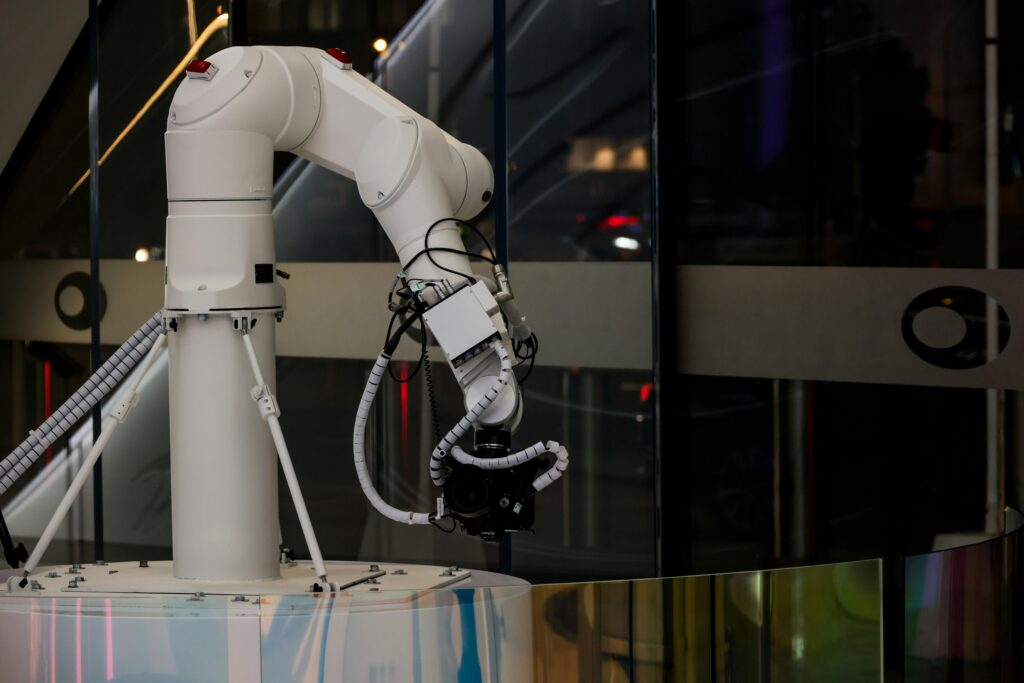
Robotics and Collaborative Robots (Cobots): AI is making industrial robots more intelligent and adaptable. AI-powered vision systems allow robots to identify and grasp objects in unstructured environments, a task that was previously very difficult for traditional automation. Cobots are designed to work safely alongside humans, taking over repetitive or ergonomically challenging tasks. An example is a cobot that lifts a heavy component into place while a human worker performs the final, delicate assembly. This collaboration enhances human productivity and reduces the risk of workplace injuries. AI-driven predictive maintenance tools can also help boost labor productivity by 5% to 20%, according to a 2022 Deloitte study.
Process Optimization and Control: AI systems can monitor production processes in real time and make autonomous adjustments to maintain optimal performance. For example, in an injection molding process, an AI can analyze sensor data to adjust temperature and pressure settings on the fly to minimize defects and reduce material waste. This creates a self-optimizing system that continuously learns and improves, a concept at the heart of the smart factory and the broader vision of artificial intelligence production environments that require minimal human intervention.
AI-Powered Copilots for the Frontline Workforce: A new wave of tools involves providing frontline workers with AI assistants, or ‘copilots’. These tools, often accessed via tablets or augmented reality glasses, can provide step-by-step instructions for complex assembly tasks, help diagnose equipment problems using natural language, and surface critical information from technical manuals instantly. Companies like Siemens and Rockwell Automation are embedding these copilots directly into their factory software to assist with tasks like generating PLC code and troubleshooting errors. This empowers the workforce, reduces training time, and minimizes human error on the shop floor.
Real-World AI in Manufacturing Examples: Who is Leading the Way?
Understanding how AI in manufacturing works in theory is one thing; seeing it in practice across leading global companies provides a clearer picture of its transformative potential. The following examples of manufacturing AI adoption demonstrate the breadth and depth of the technology’s impact across different industries and use cases.
Toyota: The benchmark for modern manufacturing has made AI a central pillar of its future strategy. In FY2025, Toyota committed 1.7 trillion yen ($10.6 billion USD) to AI and software-centered vehicles. Its Smart Factory vision focuses on using AI to augment human workers, capturing design know-how from engineers, flagging safety issues in real time, and empowering workers to develop their own machine learning models. Toyota also launched the Toyota Software Academy, offering approximately 100 training courses in AI and data security to upskill its workforce.
Renault: The French automotive manufacturer deployed predictive maintenance AI tools across its production facilities, resulting in €270 million in savings on energy and maintenance costs in a single year, as reported by its then-CEO during the Q4 2023 earnings call. This is one of the most concrete and well-documented examples of the financial ROI that AI can deliver in a manufacturing context.
Pegatron: The Taiwan-based electronics manufacturer built its automated optical inspection tool, PEGA AI, using NVIDIA’s Omniverse Replicator, Isaac Sim, and Metropolis platforms. The result was a reported 99.8% defect detection accuracy and a 4x improvement in inspection throughput, demonstrating the power of computer vision AI for quality control in high-volume electronics manufacturing.
BMW: The German automaker uses deep learning and AI vision to identify defects and blemishes at the microscopic level in automotive parts. This level of precision inspection is impossible to achieve consistently with human inspectors alone, and it ensures that BMW’s quality standards are maintained across its global production network.
General Motors: GM has implemented AI in its Super Cruise advanced driver assistance system, using multiple AI models to process real-time data from vehicle cameras and external sources. This implementation showcases how modern cloud-based data architecture can support complex, safety-critical AI applications in the automotive manufacturing process.
Georgia-Pacific: The US-based pulp and paper company captures hundreds of millions of dollars in annual value from its AI projects, including a generative AI-based document generation tool, an AI-powered chatbot for real-time guidance for operators, and an AI-powered vision system for automated defect detection. This example is notable because it demonstrates AI adoption across multiple functional areas simultaneously, rather than a single isolated use case.
How Do You Measure the ROI of AI in Manufacturing?
While the transformative potential of AI is clear, securing investment and scaling initiatives requires a rigorous approach to measuring Return on Investment (ROI). Vague promises of “improved efficiency” are insufficient; leaders must track specific, quantifiable metrics that directly link AI implementation to business value. A successful ROI strategy focuses on tracking key performance indicators (KPIs) across different operational domains. According to a study by MIT and Databricks, 76% of manufacturing leaders expect AI to deliver efficiency gains of more than 25% within two years.
The most effective way to measure ROI is to establish a baseline for key metrics before implementation and then track their improvement over time. This allows for a clear, data-driven assessment of an AI project’s value.
| Category | Key Performance Indicator (KPI) | Description and AI Impact |
|---|---|---|
| Asset & Equipment Performance | Overall Equipment Effectiveness (OEE) | A composite score of availability, performance, and quality. AI boosts OEE by using predictive maintenance to increase availability, optimizing processes to improve performance, and reducing defects to enhance quality. |
| Mean Time Between Failures (MTBF) | The average time a piece of equipment operates before failing. AI-driven predictive maintenance directly increases MTBF by identifying and addressing potential issues before they cause a breakdown. | |
| Unplanned Downtime | The percentage of time production is halted due to unexpected failures. This is a primary target for AI, with some companies avoiding as much as 12 hours of downtime per single predictive maintenance event. | |
| Quality Management | First Pass Yield (FPY) | The percentage of products manufactured correctly to specification without any rework. AI-powered computer vision and process control dramatically increase FPY by catching defects in real time. |
| Scrap Rate | The percentage of material wasted during production. AI minimizes scrap by optimizing machine parameters and identifying quality deviations early, before significant material is wasted. | |
| Cost of Quality (CoQ) | The total cost associated with preventing, detecting, and remediating defects. AI reduces all aspects of CoQ, from appraisal costs via automated inspection to failure costs by preventing recalls. | |
| Supply Chain & Inventory | Inventory Turnover | The number of times inventory is sold or used in a period. AI-driven demand forecasting allows for leaner inventory, increasing turnover and freeing up working capital. |
| On-Time In-Full (OTIF) | The percentage of orders delivered on schedule and with the correct quantity. AI optimizes production scheduling and logistics to improve OTIF, enhancing customer satisfaction. | |
| Workforce Productivity | Labor Productivity | Output per labor hour. AI augments human workers with copilots and automates repetitive tasks with robotics, allowing employees to focus on higher-value activities. |
| Time to Competency | The time it takes for a new employee to become fully proficient in their role. AI-powered training simulations and guided work instructions can significantly reduce this time. |
What are the Risks and Challenges of AI in Manufacturing?
Despite the immense potential, the path to implementing and scaling artificial intelligence in manufacturing industry environments is fraught with challenges. Understanding these barriers is as important as understanding the opportunities, because the gap between a successful pilot and an enterprise-wide transformation is where most companies stall. Acknowledging and proactively addressing these risks is crucial for a successful transformation. The challenges are not merely technical; they span data infrastructure, workforce skills, and organizational governance.
Data Infrastructure and Quality: The most frequently cited barrier to AI adoption is the state of a company’s data. AI models are only as good as the data they are trained on, and many manufacturers suffer from “data silos,” where information is trapped in disparate, legacy systems such as MES, SCADA, and ERP platforms. According to one study, 36% of manufacturers support ten or more different systems, creating a fragmented data landscape. Without a unified, high-quality data foundation, AI initiatives are likely to fail. This requires investment in modern data architectures, such as data lakehouses, that can consolidate and govern data from across the entire organization.
High Initial Cost and Scalability: The upfront investment for AI can be substantial, encompassing new hardware, software licenses, and infrastructure modernization. For small and medium-sized manufacturers (SMEs), this can be a significant hurdle. A common pitfall is “pilot purgatory,” where companies successfully run small-scale pilot projects but fail to scale them across the enterprise due to prohibitive costs or complexity. A strategic approach involves starting with high-ROI use cases, such as computer vision for quality control, and leveraging cloud-based AI platforms to minimize initial capital expenditure.
The Manufacturing Workforce Skills Gap: There is a significant shortage of workers with the skills needed to develop, implement, and maintain AI systems. A 2025 survey found that 45% of manufacturers cited a “lack of internal expertise or knowledge” as their top barrier to AI adoption. This is not just about hiring data scientists; it is about upskilling the existing workforce. Maintenance technicians, process engineers, and machine operators need to be trained to work with and trust AI-driven insights and systems. In response, 60% of manufacturers are now actively investing in training and upskilling programs for their current employees.
Model Drift and Maintenance: An AI model is not a one-time installation. Its performance can degrade over time as production conditions change, a phenomenon known as “model drift.” For example, a quality inspection model trained on images from one production line may perform poorly if a new type of raw material is introduced. This requires continuous monitoring, retraining, and validation of AI models to ensure they remain accurate and reliable. This operational aspect, often referred to as MLOps (Machine Learning Operations), is a critical but often overlooked component of a successful AI strategy.
Security of Operational Technology (OT): As AI connects factory floor equipment (OT) to cloud-based analytics platforms (IT), it creates new potential entry points for cyberattacks. A security breach that compromises an AI system controlling physical machinery could lead to production sabotage, safety incidents, or the theft of valuable intellectual property. A robust cybersecurity strategy that bridges the IT/OT divide is essential, incorporating network segmentation, anomaly detection, and strict access controls for all connected systems.
What is a Phased Roadmap for AI Implementation in Manufacturing?
Successfully integrating AI into a manufacturing operation is a journey, not a single event. It requires a strategic, phased approach that builds momentum, demonstrates value, and manages complexity. Attempting a “big bang” implementation across an entire organization is a recipe for failure. A more effective method involves a four-phase roadmap that moves from foundational preparation to enterprise-wide transformation.
Phase 1: Strategy and Foundation (Months 1–3). This initial phase is about planning and preparation. The goal is to align the AI strategy with business objectives and build the necessary data infrastructure. A cross-functional team of operations, IT, and business leaders should identify two or three initial use cases with a clear, measurable ROI, focusing on solving a specific, painful problem such as a production line with high downtime or a product with consistent quality issues. Alongside use case selection, a thorough data audit should be conducted to assess the quality, accessibility, and volume of data required, identifying silos and creating a plan to unify data sources. A governance framework should also be established at this stage, defining clear guidelines for data ownership, security, and privacy.
Phase 2: Pilot and Proof of Value (Months 4–9). In this phase, the goal is to execute a pilot project to demonstrate the value of AI in a controlled environment, which is crucial for building organizational buy-in. The AI solution should be implemented for the selected use case on a single production line or in one factory. The KPIs identified in the ROI framework must be rigorously tracked and compared against the pre-implementation baseline to build a data-driven business case for expansion. Simultaneously, a core group of employees who will work with the new system should begin their upskilling journey, as their feedback will be invaluable for refining the solution.
Phase 3: Scale and Industrialize (Months 10–18). With a successful pilot, the focus shifts to scaling the solution across more assets, lines, or facilities. The technology stack must be refined to ensure it can support a broader deployment, which may involve moving from a cloud-based pilot to a hybrid model that incorporates edge computing for real-time processing. A formal MLOps practice should be established to monitor, retrain, and manage the lifecycle of AI models as they are scaled. A comprehensive training program should also be rolled out to upskill the broader workforce, which is essential for driving adoption and ensuring that employees trust and effectively utilize the AI tools.
Phase 4: Innovate and Transform (Months 19+). In the final phase, AI is no longer a series of discrete projects but a core capability embedded within the organization. With a mature data platform and a skilled workforce, the organization can tackle more complex challenges such as generative design, supply chain digital twins, and autonomous process control. The focus shifts to democratizing access to AI tools and insights across all levels of the organization, fostering a culture of continuous improvement and data-driven decision-making that creates a durable, long-term competitive advantage.
What is the Future of AI in Manufacturing?
The trajectory of AI in manufacturing is pointing toward a future of greater autonomy, intelligence, and connectivity. While current applications are already delivering significant value, several emerging trends are set to further revolutionize the industry.
Agentic AI and Physical AI: The next frontier is the move from predictive AI to agentic AI, systems that can not only analyze and predict but also reason, plan, and take autonomous action to achieve goals. An agentic AI system could, for example, detect a supply chain disruption, identify alternative suppliers, negotiate contracts, and re-route shipments, all with minimal human oversight. This lays the foundation for physical AI, where more autonomous robots, including humanoid robots, can perform complex physical tasks in unstructured factory environments. Among respondents to a survey by the Manufacturing Leadership Council in early 2025, nearly one-quarter of manufacturers plan to use physical AI within just two years, a more than twofold increase from today.
Industrial Foundation Models: Similar to how large language models (LLMs) like GPT have transformed text generation, the industry is moving toward domain-specific foundation models for manufacturing. These models will be pre-trained on massive datasets of industrial data, including sensor readings, machine logs, and process parameters, and can be fine-tuned for specific tasks like process optimization or root cause analysis. This will dramatically accelerate the development and deployment of AI applications across the sector.
Edge AI and Real-Time Processing: As AI applications require lower latency and greater data security, there is a growing shift from purely cloud-based AI to Edge AI. This involves running AI models directly on hardware located on the factory floor. The maturation of powerful and efficient edge computing hardware, such as NVIDIA’s Jetson platform, is making it possible to perform complex AI tasks like real-time video analytics and robotic control without the delay of sending data to the cloud and back. Industrial DataOps, the fastest-growing industrial software segment, is also emerging as a critical enabler, expected to grow at a 49% CAGR until 2028.
Conclusion: The Dawn of the Self-Optimizing Factory
Artificial intelligence in manufacturing is not a distant vision; it is a present-day reality that is fundamentally reshaping how products are designed, produced, and delivered. From the predictive power of machine learning that averts costly downtime to the creative potential of generative design that reimagines product engineering, AI is providing the tools to build factories that are not just automated, but intelligent. The journey begins with a strategic understanding of how AI can solve specific, high-value problems and a commitment to building a robust data foundation.
The path is not without its challenges. It demands significant investment, a new set of workforce skills, and a rigorous approach to governance and security. However, as the data from market growth and real-world ROI demonstrates, the cost of inaction is far greater than the cost of adoption. The companies that will lead the next era of industrial innovation will be those that embrace the Sense-Think-Act paradigm, transforming their operations into self-optimizing, data-driven ecosystems. By starting with a clear strategy, proving value through targeted pilots, and scaling with discipline, manufacturers can harness the power of AI to not only survive but thrive in an increasingly complex and competitive world history.
How Intelycx Helps Turn Manufacturing KPIs into Daily Guidance
Manufacturing KPIs only create value when they are accurate, real-time, and connected to action. That is the gap Intelycx is built to close.
The Intelycx platform connects legacy and modern machines into a single data foundation, normalizes and enriches signals so KPIs are calculated consistently across lines and sites, and provides real-time dashboards for operators, engineers, and leaders. On top of this connected data, Intelycx layers AI-driven insights so teams understand not just what changed in a KPI, but why, and what to do about it.
If you are working to move beyond spreadsheets and lagging reports, a unified manufacturing AI platform like Intelycx can help you turn KPIs from static charts into a living system for maximizing production efficiency every day. You can learn more about our solutions and approach at intelycx.com.