The machines on most industrial production floors were engineered to last 20 years. The competitive landscape they operate in changes every two. This is the Asset Lifecycle Paradox: the more a manufacturer invests in heavy, durable production assets, the more brittle their operation becomes in the face of rapid market shifts. That gap between the long lifecycle of physical assets and the accelerating pace of market demand is the defining tension of industrial manufacturing today. Manufacturers who close it gain a measurable edge. Those who do not absorb the cost in unplanned downtime, defective output, and lost institutional knowledge.
This article provides a definitive answer to “what is industrial manufacturing” by framing it as a strategic challenge rather than a technical definition. We will explore the industrial manufacturing process, the core segments of the industry, and how to implement modern smart manufacturing technology to bridge the gap between legacy assets and modern agility.
Industrial Manufacturing Explained
Industrial manufacturing is the systematic, large-scale transformation of raw materials, components, and parts into finished goods using machinery, labor, and controlled production processes, with the output intended for use by other industries, businesses, or infrastructure rather than direct consumer retail. It is the foundational layer of the global economy: the sector that produces the equipment, machinery, and industrial products that make all other manufacturing and commerce possible.
| Attribute | Value |
|---|---|
| Primary function | Transforms raw materials into finished industrial goods at scale |
| Output destination | Other industries, OEMs, infrastructure, B2B customers |
| Production method | Machinery, automated systems, skilled labor, controlled processes |
| Economic role | Contributes approximately 15% of global GDP (World Bank, 2024) |
| Workforce structure | 70% of companies employ fewer than 100 people (SAP, 2024) |
| Asset characteristic | Production equipment lifecycles of 10–20 years |
| Key performance metric | Overall Equipment Effectiveness (OEE) |
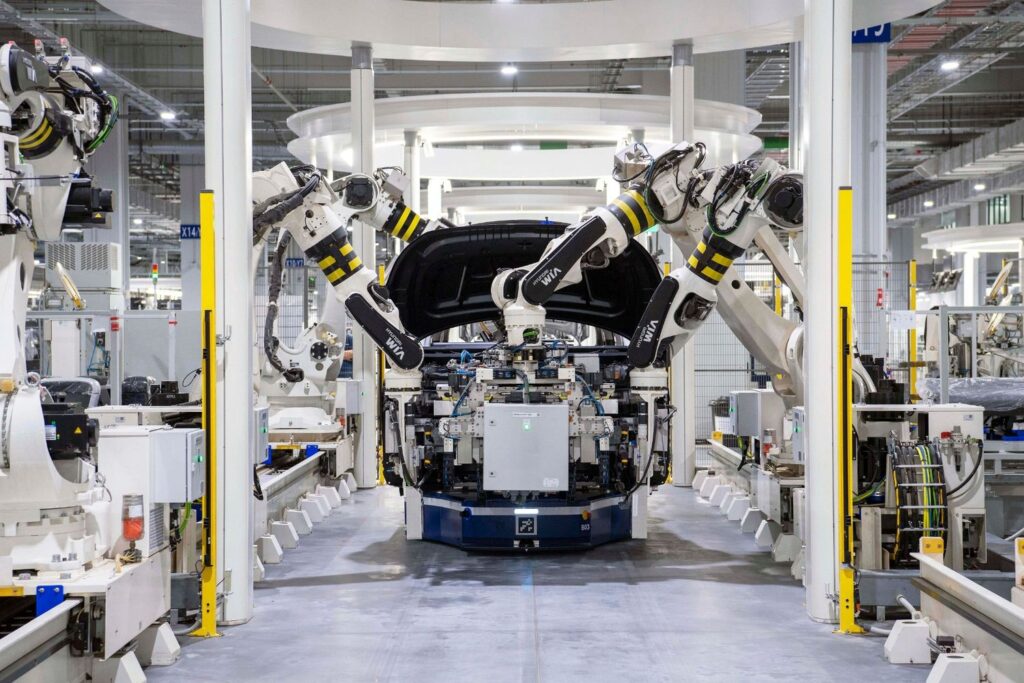
The industrial manufacturing definition distinguishes this sector from consumer goods manufacturing by its B2B orientation and the industrial nature of its output. An automotive stamping plant producing body panels for a vehicle assembly line is industrial manufacturing. A bakery producing bread for retail is not. The output of industrial manufacturing enables other production. It is the machinery, components, tooling, and industrial products that other industries depend on to function.
What Is the History of Industrial Manufacturing?
The history of industrial manufacturing is the history of moving from human-scale limitations to machine-scale capacity. The First Industrial Revolution (late 18th century) introduced mechanization powered by water and steam, transitioning production from artisanal hand methods to machine-assisted output. The Second Industrial Revolution (late 19th century) brought electrification and the assembly line, enabling true mass production. The Third Industrial Revolution (late 20th century) introduced programmable logic controllers (PLCs) and early automation, allowing machines to execute complex, repeatable sequences without continuous human intervention. Today, we are in the Fourth Industrial Revolution (Industry 4.0), where the focus has shifted from mechanization to connectivity, with machines that communicate, learn, and adjust autonomously.
What Are the Core Segments of Industrial Manufacturing?
Industrial manufacturing comprises five distinct segments: discrete, process, heavy industry, light industry, and advanced manufacturing. Each operates with different production logic, capital requirements, and technology needs.
Discrete manufacturing produces distinct, countable items (automobiles, aerospace components, electronics, industrial machinery) that can be disassembled back into their constituent parts. These operations are characterized by complex bills of materials (BOMs), assembly-focused workflows, and high variation in product configuration. A single industrial machine may have thousands of individual components sourced from dozens of suppliers.
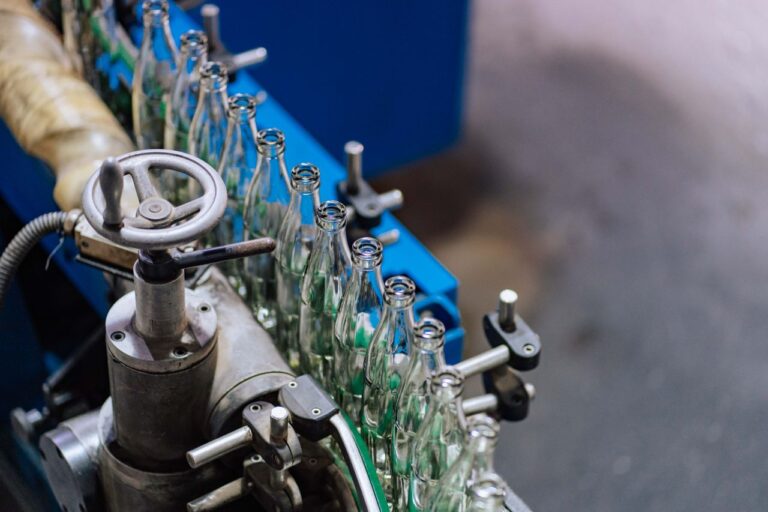
Process manufacturing transforms raw materials through chemical, biological, or physical reactions to produce goods measured in continuous quantities rather than discrete units. Chemicals, pharmaceuticals, food and beverage, petroleum products, and textiles fall into this category. The output cannot be disassembled; a batch of pharmaceutical compound cannot be separated back into its precursor chemicals.
Heavy industry encompasses the production of large-scale industrial equipment, infrastructure components, and raw material processing (steel production, mining equipment, construction machinery, and shipbuilding). These operations require massive capital investment, consume significant energy, and produce output with multi-decade service lives.
Light industry covers the manufacturing of smaller consumer-facing components and goods (electronics, furniture, clothing, and household items). It requires less capital investment than heavy industry but demands high precision and rapid product cycle management.
Advanced manufacturing integrates cutting-edge technologies (robotics, AI, additive manufacturing, and digital twins) to produce high-value, precision goods in sectors such as aerospace, medical devices, and semiconductor fabrication. This segment is growing fastest and attracting the majority of new capital investment.
| Segment | Output Type | Production Logic | Example Sectors |
|---|---|---|---|
| Discrete | Countable, assemblable units | BOM-driven, assembly-focused | Automotive, aerospace, electronics, industrial machinery |
| Process | Continuous or bulk quantities | Formula/recipe-driven, batch or continuous | Chemicals, pharma, food/beverage, petroleum |
| Heavy Industry | Large-scale equipment and materials | Capital-intensive, long-cycle | Steel, mining equipment, shipbuilding, construction materials |
| Light Industry | Smaller consumer components | Precision-focused, high-volume | Electronics, furniture, clothing, household goods |
| Advanced | High-value precision products | Technology-integrated, flexible | Aerospace, medical devices, semiconductors |
How Does the Industrial Manufacturing Process Work?
The industrial manufacturing process converts raw material inputs into finished industrial goods through a sequence of six controlled operations: acquisition, planning, fabrication, assembly, quality control, and distribution. While the specific steps vary by segment and product, the core industrial manufacture logic follows a consistent sequence across all segments of the sector.
Raw material acquisition is the first stage: sourcing metals, plastics, chemicals, natural resources, and components from a multi-tier supply chain. The quality, availability, and cost of raw materials directly determine production efficiency and unit economics. Industrial manufacturers managing complex supply chains must coordinate across Tier 1, Tier 2, and Tier 3 suppliers simultaneously.
Production planning translates customer orders and demand forecasts into manufacturing schedules, resource allocation plans, and machine utilization targets. Effective production planning is the difference between a factory running at 85% OEE and one running at 55%.
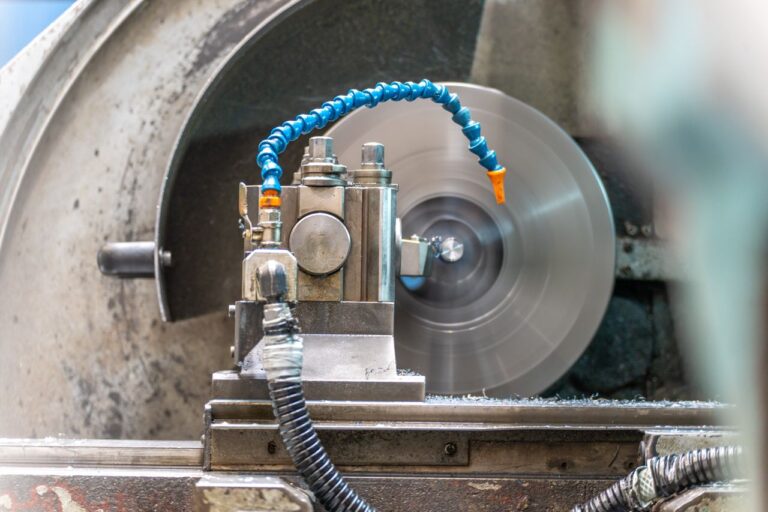
Machining and fabrication transforms raw materials into components using CNC machines, laser cutting, forming, casting, and other precision processes. This stage is where the physical transformation occurs and where the majority of quality defects originate.
Assembly combines fabricated components into finished products. In discrete manufacturing, this stage can involve hundreds of sequential operations, each with its own quality checkpoint.
Quality control verifies that finished goods meet dimensional, functional, and regulatory specifications before leaving the production floor. At high throughput of 75,000 units per day or more, manual visual inspection becomes statistically unreliable, which is why AI-powered visual inspection systems are replacing human inspectors in high-volume industrial manufacturing environments.
Packaging and distribution prepares finished goods for shipment to OEM customers, distributors, or end-use facilities.
The four primary production methods used across these stages are:
- Batch production: goods are manufactured in defined quantities from start to finish before the next batch begins. Flexible and suitable for moderate-volume products with variable demand.
- Mass production: standardized goods produced continuously on assembly lines, with multiple batches at different stages simultaneously. Maximizes throughput but limits flexibility.
- Continuous production: fully automated, uninterrupted production used in process industries such as chemicals and petroleum. Cannot be changed without a full system shutdown.
- Custom manufacturing: small-batch production of unique goods to specific customer specifications. Common in aerospace, medical devices, and precision industrial equipment.
What Industries Does Industrial Manufacturing Serve?
Any industrial manufacturing industry overview must account for the breadth of sectors that depend on this foundational layer. Industrial manufacturing serves every major sector of the economy, and the manufacturing and industrial relationship is bidirectional: the products of industrial and manufacturing enterprises enable other industries to manufacture, build, and operate.
Automotive is the largest single consumer of industrial manufacturing output, relying on stamped metal components, precision-machined parts, electronic assemblies, and industrial tooling. Automotive manufacturing demands just-in-time delivery, zero-defect quality standards, and the ability to support frequent model changes without retooling delays.
Aerospace and defense requires the highest precision tolerances in industrial manufacturing, as components must meet certification standards where failure is not an option. Custom manufacturing and advanced composites dominate this segment, with development cycles measured in years and asset lifecycles measured in decades.
Electronics and semiconductors represent the fastest-growing demand segment for industrial manufacturing. As of July 2025, private sector commitments to revitalize the US chipmaking ecosystem exceeded $500 billion, with domestic semiconductor capacity projected to triple by 2032. The industrial products manufacturing required to build and equip semiconductor fabrication facilities (cleanroom systems, precision robotics, advanced metrology equipment) is one of the most technically demanding in the sector.
Pharmaceuticals and medical devices operate under the most stringent regulatory environment in industrial manufacturing. FDA-regulated manufacturers must maintain cradle-to-grave traceability for every component, with batch records, validation documentation, and quality management systems that leave no room for undocumented process variation.
Food and beverage combines high-volume continuous production with strict hygiene standards and seasonal demand variability. Industrial manufacturing technology in this sector focuses on sanitary design, automated inspection, and supply chain traceability.
What Are the Biggest Operational Challenges in Industrial Manufacturing?
Industrial manufacturers face three structural challenges that no amount of process improvement alone can solve. Each challenge is a direct consequence of the Asset Lifecycle Paradox: the mismatch between 20-year machines and a 2-year competitive cycle.
The Data Visibility Gap is the most pervasive challenge in industrial manufacturing. The majority of production equipment on factory floors today was designed before industrial IoT existed. These machines generate no digital data by default, meaning they cannot report their own utilization, cycle times, or fault states. As a result, production managers make scheduling and maintenance decisions based on lagging indicators: shift reports, manual counts, and maintenance logs written after the fact. A machine running at 60% of its rated capacity generates no alert. A quality deviation accumulating over three shifts produces no warning. The cost of this invisibility is absorbed silently, in unplanned downtime and scrap. Intelycx CORE solves this by connecting legacy machines to a real-time data layer without requiring equipment replacement, reducing unplanned downtime by up to 20% and enabling live OEE monitoring across the entire production floor.
The Knowledge Retention Crisis is the second structural challenge. The industrial manufacturing workforce is aging faster than it is being replaced. The most experienced operators (those who know which machine vibrates differently before a bearing fails, which supplier’s material runs 3% harder than spec, which product variant needs a non-standard setup) are retiring. This Tribal Knowledge is not written down anywhere. It exists only in the memory of the people who accumulated it over 20 or 30 years on the floor. When they leave, it leaves with them. The cost is measured in slower onboarding, more frequent defects during setup, and the permanent loss of process intelligence that took decades to build. Intelycx ARIS digitizes this knowledge through AI-powered capture and retrieval, delivering a 40% reduction in onboarding time and making institutional expertise accessible via chat, voice, and mobile interfaces on the production floor.
The Quality Inspection Bottleneck is the third challenge. As production volumes increase and product complexity grows, manual visual inspection becomes the rate-limiting constraint on throughput. A human inspector examining 75,000 units per day at a sustained accuracy rate is a statistical impossibility, as fatigue, lighting variation, and cognitive load degrade performance over a shift. Yet the cost of a defective product reaching a customer in automotive, aerospace, or medical device manufacturing can be catastrophic: recalls, regulatory action, and permanent damage to supplier relationships. Intelycx NEXACTO replaces manual visual inspection with AI-powered machine vision that operates at 75,000 units per day with 99%+ accuracy, detecting surface defects as small as 250 microns in just 4.5 seconds per cycle.
How Is Technology Transforming Industrial Manufacturing?
Industrial manufacturing technology is transforming operations through three interconnected layers: machine connectivity (IIoT), artificial intelligence (AI), and digital twins. What is new is the convergence of these technologies into deployable, scalable industrial manufacturing solutions that work on existing factory infrastructure without requiring a greenfield rebuild.
While many industry sources state that full MES replacement is required for digital transformation, Intelycx offers a different path. Rather than a costly rip-and-replace project, the Intelycx smart manufacturing platform integrates with your existing MES via REST APIs, MQTT, and OPC-UA, providing a real-time data layer without system replacement. The platform operates as an integrated ecosystem: Intelycx CORE provides data to Intelycx ARIS for contextual operator guidance, and Intelycx CORE provides data to Intelycx NEXACTO to correlate machine states with defect rates.
Industrial IoT (IIoT) connects machines, sensors, and production systems into a unified data network, enabling real-time visibility into machine states, production rates, energy consumption, and quality metrics. IIoT is the prerequisite for every other advanced technology in industrial manufacturing: without data, there is no analytics, no AI, and no predictive maintenance.
Artificial intelligence and machine learning apply pattern recognition to the data streams generated by IIoT infrastructure. Predictive maintenance algorithms identify anomalous machine behavior 48–72 hours before failure, enabling scheduled intervention instead of emergency repair. AI-powered quality inspection systems detect defects that human inspectors miss. Process optimization models identify the combination of machine parameters, material inputs, and environmental conditions that maximizes yield.
Digital twins create virtual replicas of physical production systems, enabling manufacturers to simulate process changes, test new product configurations, and model the impact of equipment failures before they occur on the physical floor.
How to Implement Industrial Manufacturing Technology: A 3-Step Roadmap
To successfully deploy industrial manufacturing solutions without disrupting current operations, manufacturers must follow a structured implementation roadmap.
Step 1: Connect the Legacy Floor If you have legacy equipment, Intelycx provides retrofit kits. Do not wait for new capital equipment to begin data collection. Use Intelycx CORE to establish Edge-to-Cloud connectivity across your oldest machines first, as these are typically the sources of the most significant unplanned downtime.
Step 2: Automate the Quality Bottleneck Once data is flowing, identify the inspection point that causes the most significant throughput constraint. If manual inspectors are slowing down a high-volume line, deploy Intelycx NEXACTO to automate the visual inspection process. This immediately removes the bottleneck and provides 100% inspection coverage.
Step 3: Digitize the Workforce Knowledge As veteran operators prepare for retirement, use Intelycx ARIS to capture their troubleshooting routines. If a complex machine requires a 40-step changeover, ARIS converts that process into a step-by-step digital traveler, ensuring new hires can execute the changeover with expert-level precision.
High-Fidelity Use Case: Reclaiming Capacity in Automotive Manufacturing
Consider a Tier-1 automotive supplier struggling with an average cost of downtime in manufacturing of $25,000 per hour. Their primary bottleneck was a high-speed stamping press that suffered from frequent “Small Stops” (idling) that were never recorded in manual logs.
By implementing Intelycx CORE, the facility identified that 60% of their production downtime was caused by minor sensor misalignments that took only 2 minutes to fix but happened 20 times a shift. By standardizing the sensor calibration process in ARIS and implementing a predictive alert for sensor drift, the facility:
- Reduced Unplanned Downtime by 18%.
- Increased OEE by 12%.
- Saved $950,000 in annual EBITDA.
What Does the Future of Industrial Manufacturing Look Like?
The future of industrial manufacturing is being shaped by three converging forces: agentic AI, reshoring, and the transition from reactive to predictive operations.
Agentic AI represents the next evolution of machine intelligence. Where conventional AI provides recommendations, agentic AI takes autonomous action, such as identifying alternative suppliers during a disruption, generating shift handover reports, scheduling maintenance, and managing warranty submissions without human initiation. Among manufacturing executives surveyed by Deloitte in 2025, 22% plan to deploy physical AI (autonomous robots capable of operating in unstructured environments) within two years, up from 9% today.
Reshoring is accelerating. Eighty percent of manufacturing executives plan to invest 20% or more of their improvement budgets in smart manufacturing initiatives. Trade uncertainty, cited as the top concern by 78% of manufacturers who expect input costs to rise 5.4% over the next year, is driving a reassessment of global supply chain structures. Manufacturers are building more domestic capacity, investing in supply chain digitization, and using agentic AI to model and mitigate tariff exposure in real time.
The transition from reactive to predictive operations is the most significant internal transformation in industrial manufacturing. Aftermarket services (maintenance, spare parts, technical support) are widely recognized across the industry as delivering profit margins significantly higher than initial equipment sales alone. Manufacturers who build predictive service capabilities into their products, using real-time telemetry and AI-driven diagnostics, convert one-time equipment sales into recurring, high-margin service revenue streams.
The industrial manufacturing industry that emerges from this period will be defined not by the size of its machines but by the intelligence of its operations. Manufacturers who connect their assets, digitize their knowledge, and automate their quality processes will outperform those who do not, regardless of the age of their equipment.
Technical Glossary
Bill of Materials (BOM): A structured list of all components, subassemblies, raw materials, and quantities required to manufacture a finished product.
Continuous Production: A fully automated, uninterrupted manufacturing process used in process industries such as chemicals and petroleum, where stopping the line requires a complete system shutdown.
Discrete Manufacturing: The production of distinct, countable items that can be assembled and disassembled, such as vehicles, electronics, and industrial machinery.
Heavy Industry: Manufacturing operations involving large-scale equipment, infrastructure components, and raw material processing, characterized by high capital intensity and long asset lifecycles.
Industrial IoT (IIoT): A network of interconnected sensors, machines, and systems in industrial environments that collect and exchange real-time operational data.
OEE (Overall Equipment Effectiveness): The master KPI of industrial manufacturing, calculated as the product of Availability × Performance × Quality. A world-class OEE score is 85%; most manufacturers operate between 40% and 60%.
Process Manufacturing: The production of goods through chemical, biological, or physical transformation, resulting in homogenous products measured in continuous quantities rather than discrete units.
Tribal Knowledge: Operational expertise accumulated by experienced workers over years of hands-on production experience that is not formally documented and is lost when those workers retire or leave.
Agentic AI: Artificial intelligence systems capable of autonomous reasoning, planning, and action, moving beyond recommendations to independently executing tasks such as supplier sourcing, maintenance scheduling, and warranty processing.
Digital Twin: A virtual replica of a physical production asset, process, or system, used to simulate, monitor, and optimize real-world operations without physical intervention.
Predictive Maintenance: A maintenance strategy that uses real-time machine data and AI to identify failure signatures before breakdown occurs, enabling scheduled intervention and eliminating unplanned downtime.
Manufacturing Value Added (MVA): An economic metric that measures the contribution of the manufacturing sector to an economy’s total output, used to compare industrial productivity across countries.
How Intelycx Helps Turn Manufacturing KPIs into Daily Guidance
Manufacturing KPIs only create value when they are accurate, real-time, and connected to action. That is the gap Intelycx is built to close.
The Intelycx platform connects legacy and modern machines into a single data foundation, normalizes and enriches signals so KPIs are calculated consistently across lines and sites, and provides real-time dashboards for operators, engineers, and leaders. On top of this connected data, Intelycx layers AI-driven insights so teams understand not just what changed in a KPI, but why, and what to do about it.
If you are working to move beyond spreadsheets and lagging reports, a unified manufacturing AI platform like Intelycx can help you turn KPIs from static charts into a living system for maximizing production efficiency every day. You can learn more about our solutions and approach at intelycx.com.